Understanding the difference between “worse” and “worst” can be confusing for many English learners and native speakers alike. These two words look similar but serve different purposes in sentences.
People often search for “worse or worst” because they want to write or speak correctly, especially in emails, essays, and professional communication. Using the wrong word can make your writing seem unprofessional or unclear.
In this guide, we will explain the difference between worse and worst, their origins, proper usage, common mistakes, and how people around the world use them. By the end, you will know exactly when to use each word and avoid common errors in writing and speech.
Worse or Worst – Quick Answer
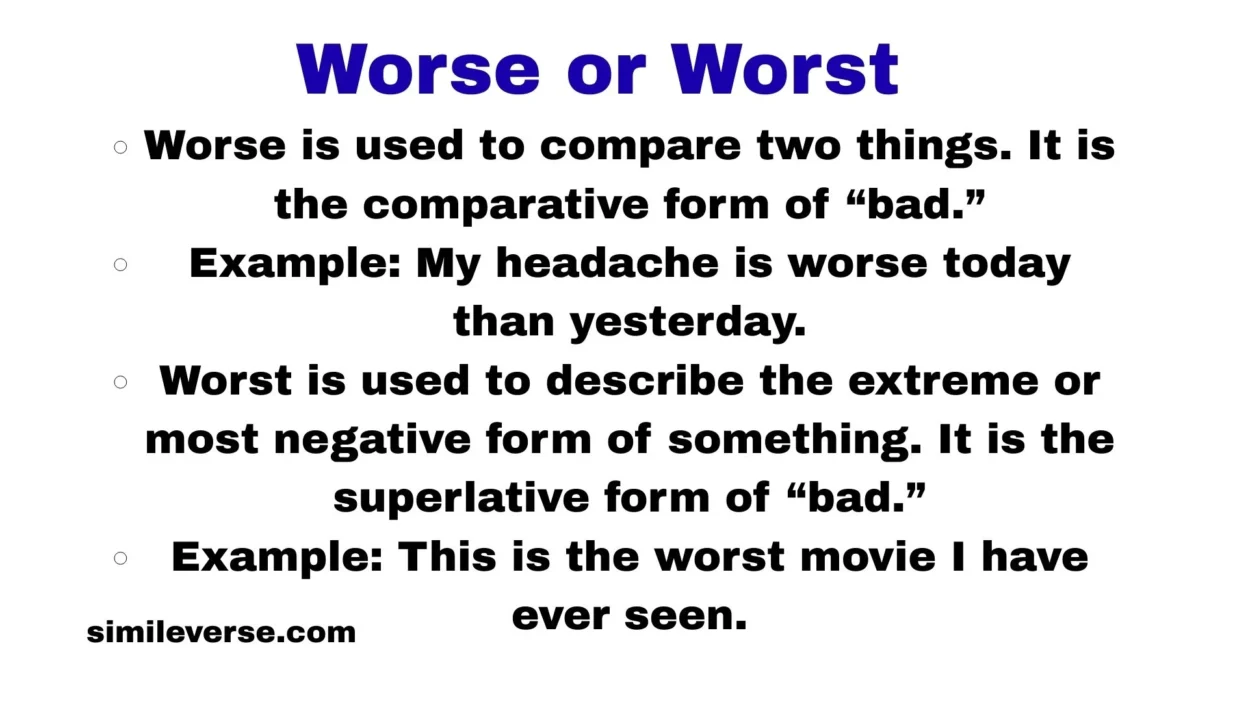
- Worse is used to compare two things. It is the comparative form of “bad.”
Example: My headache is worse today than yesterday. - Worst is used to describe the extreme or most negative form of something. It is the superlative form of “bad.”
Example: This is the worst movie I have ever seen.
Quick Tip: Use worse when comparing two items, and worst when highlighting the extreme of a group or situation.
The Origin of Worse or Worst
Both words come from Old English:
- Worse comes from “wiersa,” meaning “more bad.”
- Worst comes from “wyrrest,” meaning “most bad.”
These words have remained largely the same for centuries, making them reliable choices in modern English. Their similarity causes confusion, but remembering their comparative and superlative roles can prevent mistakes.
British English vs American English Spelling
Good news: “worse” and “worst” are spelled the same in both British and American English. There is no regional spelling difference.
| Word | British English | American English | Use Case Example |
|---|---|---|---|
| Worse | Worse | Worse | My situation is worse than yesterday. |
| Worst | Worst | Worst | This is the worst experience of my life. |
Unlike words such as “colour/color” or “theatre/theater,” there is no spelling variation, so you can use the same rules globally.
Which Word Should You Use?
- Use “worse” when comparing two things or situations.
- Use “worst” when describing the extreme case in a group of three or more items.
Audience Tip: Whether you write for American, British, or global readers, stick to this rule. There is no regional difference, so it’s all about context.
Common Mistakes with Worse or Worst
- Incorrect: This is worse movie I have seen.
Correct: This is the worst movie I have seen. - Incorrect: My situation is worst today than yesterday.
Correct: My situation is worse today than yesterday. - Incorrect: He is the worse player on the team.
Correct: He is the worst player on the team.
Tip: If you are comparing two items, choose worse. If highlighting the extreme, choose worst.
Worse or Worst in Everyday Examples
- Email: “The traffic today is worse than yesterday.”
- News: “This is the worst storm the city has seen in decades.”
- Social Media: “Worst day ever 😢”
- Formal Writing: “Among the submitted reports, this one is the worst in quality.”
Using the correct word improves clarity and professionalism.
Worse or Worst – Google Trends & Usage Data
According to Google Trends, “worst” is searched slightly more often than “worse”, particularly in the US and UK. Searches spike around negative events, news stories, or viral social media content. Both words are essential for proper English communication, but “worst” often attracts more attention due to its stronger emotional impact.
Comparison Table: Worse vs Worst
| Feature | Worse | Worst |
|---|---|---|
| Type | Comparative | Superlative |
| Use | Compare two items | Extreme of three or more |
| Example 1 | Today’s weather is worse. | Today’s storm is the worst. |
| Example 2 | My headache feels worse. | That was the worst headache. |
FAQs
Q1: Can I use worse for more than two items?
No, worse is only for comparing two things. Use worst for three or more.
Q2: Is worst always negative?
Yes, both words describe bad situations, but worst indicates the extreme.
Q3: Are these words interchangeable?
No, using the wrong form changes the meaning.
Q4: Can I use worse in formal writing?
Yes, it is correct as long as you compare two items.
Q5: Do Americans and Brits use these words differently?
No, spelling and usage are the same; context is what matters.
Q6: Is “worse than worst” correct?
Yes, it is used for emphasis in informal English. Example: “Today is worse than worst!”
Q7: Can I use worst as an adjective and noun?
Yes, “the worst” can function as both: adjective (“the worst movie”) or noun (“He is the worst”).
Conclusion
In summary, worse and worst are essential words in English but serve distinct roles. Worse compares two items or situations, while worst describes the extreme among three or more.
Both words share the same spelling in British and American English, so context is the key to proper usage.
Avoid common mistakes by remembering that worse = comparative and worst = superlative. Whether you are writing emails, social media posts, or professional reports, using these words correctly improves clarity, credibility, and reader understanding.
Mastering this small but crucial distinction ensures you communicate accurately and professionally.