Do you ever pause while writing and wonder: should I use women or woman? You’re not alone. This is one of the most searched English questions because the two words look similar, sound close, and often confuse even fluent speakers. A single extra letter can change the meaning of a sentence completely.
People search for “women or woman” when writing emails, school assignments, blog posts, job applications, or social media captions. Using the wrong form can make a sentence sound incorrect or unclear. For learners of English, this confusion is even more common because many languages do not change words the same way for singular and plural forms.
This article solves that confusion once and for all. You’ll get a quick answer, clear explanations, real-life examples, common mistakes to avoid, and simple advice on which word to use and when. Everything is written in very easy language, so anyone can understand it fast. By the end, you’ll confidently know when to use woman and when to use women, without second-guessing yourself.
Women or Woman – Quick Answer
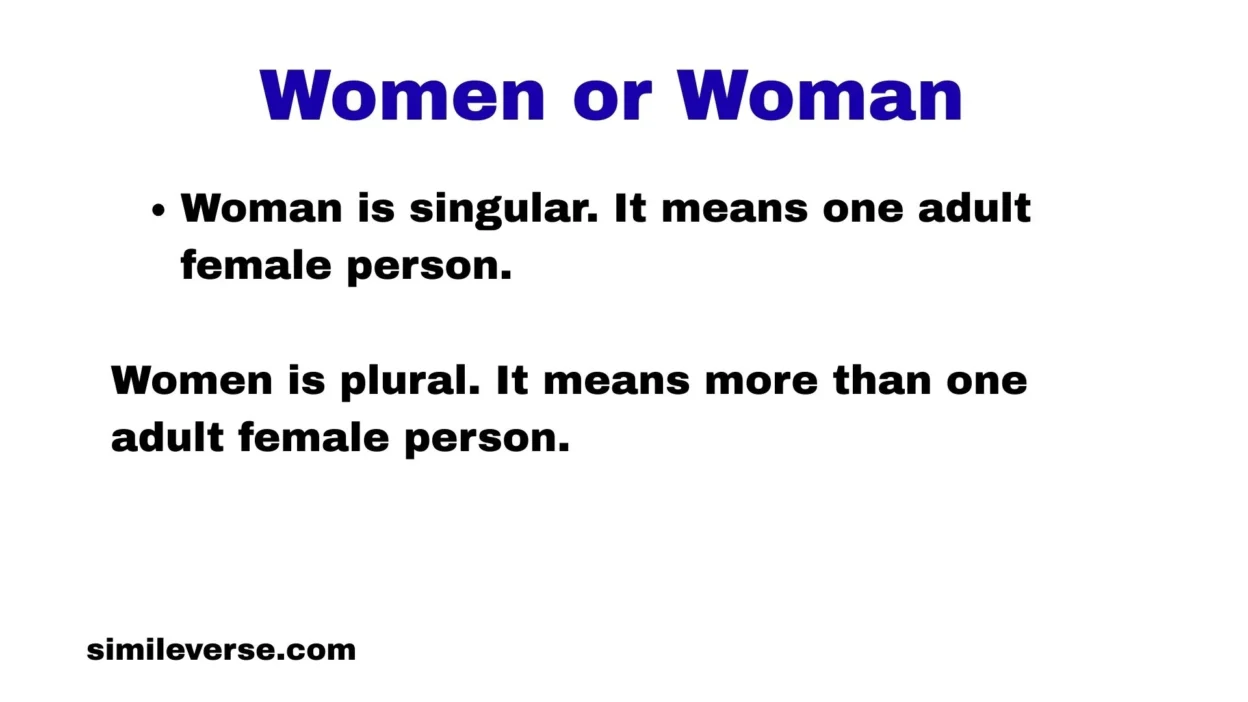
Woman is singular. It means one adult female person.
Women is plural. It means more than one adult female person.
Examples:
- She is a strong woman.
- The room is full of women.
- One woman spoke first.
- Many women agreed with her.
Simple trick:
If you mean one, use woman.
If you mean two or more, use women.
The Origin of Women or Woman
The words woman and women come from Old English.
- Woman comes from the Old English word wīfmann, meaning “female person.”
- Over time, wīfmann changed into woman.
- The plural form slowly changed into women, with a different vowel sound.
English kept this special plural form instead of adding “s” like most words. That’s why woman → women changes spelling and pronunciation. This history is why many learners find it confusing today.
British English vs American English Spelling
Good news: there is no spelling difference between British and American English for woman and women.
Both follow the same rules in all major English-speaking countries.
Comparison Table
| Form | Meaning | British English | American English |
|---|---|---|---|
| woman | One female | woman | woman |
| women | More than one | women | women |
The confusion is not about country rules. It’s about singular vs plural.
Which Spelling Should You Use?
Use the word based on how many people you are talking about.
- For the US audience:
Use woman for one, women for many. - For the UK and Commonwealth:
Same rule applies. - For global or international writing:
Stick to the number rule. Everyone understands it.
If you can replace the word with one person, choose woman.
If you can replace it with many people, choose women.
Common Mistakes with Women or Woman
Many writers make these mistakes:
❌ She is a great women.
✅ She is a great woman.
❌ One women was selected.
✅ One woman was selected.
❌ That women is my teacher.
✅ That woman is my teacher.
❌ Women is leading the team.
✅ Women are leading the team.
Tip:
- Woman = is
- Women = are
Women or Woman in Everyday Examples
Emails
- I spoke to one woman from your team.
- Several women attended the meeting.
News
- The woman won the award.
- The event honors women leaders.
Social Media
- Support every woman chasing her dream.
- Strong women inspire change.
Formal Writing
- The woman was appointed manager.
- The study focuses on women in leadership.
Women or Woman – Google Trends & Usage Data
Search data shows that “women or woman” is popular worldwide.
The question appears most in:
- Non-native English countries
- Education-related searches
- Writing and grammar help
People often search this phrase while:
- Writing exams
- Creating blog content
- Preparing resumes or reports
Woman is searched more in grammar questions.
Women is searched more in social, health, and news topics.
Women vs Woman – Side-by-Side Comparison
| Feature | Woman | Women |
|---|---|---|
| Number | Singular | Plural |
| Meaning | One female | More than one |
| Verb used | is | are |
| Example | A woman speaks | Women speak |
FAQs About Women or Woman
1. Is “women” singular or plural?
Women is plural.
2. Can I use “woman” for a group?
No. Use women for groups.
3. Why does “woman” change to “women”?
Because English kept an old plural form from history.
4. Is “women” pronounced differently?
Yes. Woman sounds like wuh-man.
Women sounds like wih-men.
5. Is the rule different in British English?
No. The rule is the same everywhere.
6. Can “women” ever be used with “a”?
No. “A” only works with woman.
Conclusion
The difference between women and woman is simple once you see it clearly. Woman refers to one female person, while women refers to more than one. The spelling does not change by country, style, or region. It only changes with number.
Most mistakes happen because people mix up the singular and plural forms or match them with the wrong verb. Remember this easy rule: one = woman, many = women. Also match the verb correctly: woman is, women are.
Whether you are writing an email, a school essay, a news article, or a social media post, using the correct word makes your writing clearer and more professional. With this guide, you no longer need to pause or guess. You now know exactly when to use woman and when to use women—every single time.