Many people search for “who’s or whose” because these two words look similar, sound the same, and are often confused in writing. Even confident English speakers pause when choosing between them. A small apostrophe can completely change the meaning of a sentence, which is why this topic creates so much doubt in emails, schoolwork, social posts, and professional writing.
The confusion usually comes from mixing up contractions and possessive forms. English has many tricky pairs like it’s/its and they’re/their, and who’s vs whose fits right into this group. Writers worry about looking unprofessional, losing marks, or sending the wrong message because of one tiny grammar mistake.
This article solves that problem clearly and quickly. You will get a fast answer, easy examples, background history, common mistakes, real-life usage, and practical advice on which form to use. By the end, you will never hesitate again when choosing between who’s and whose.
Who’s or Whose – Quick Answer
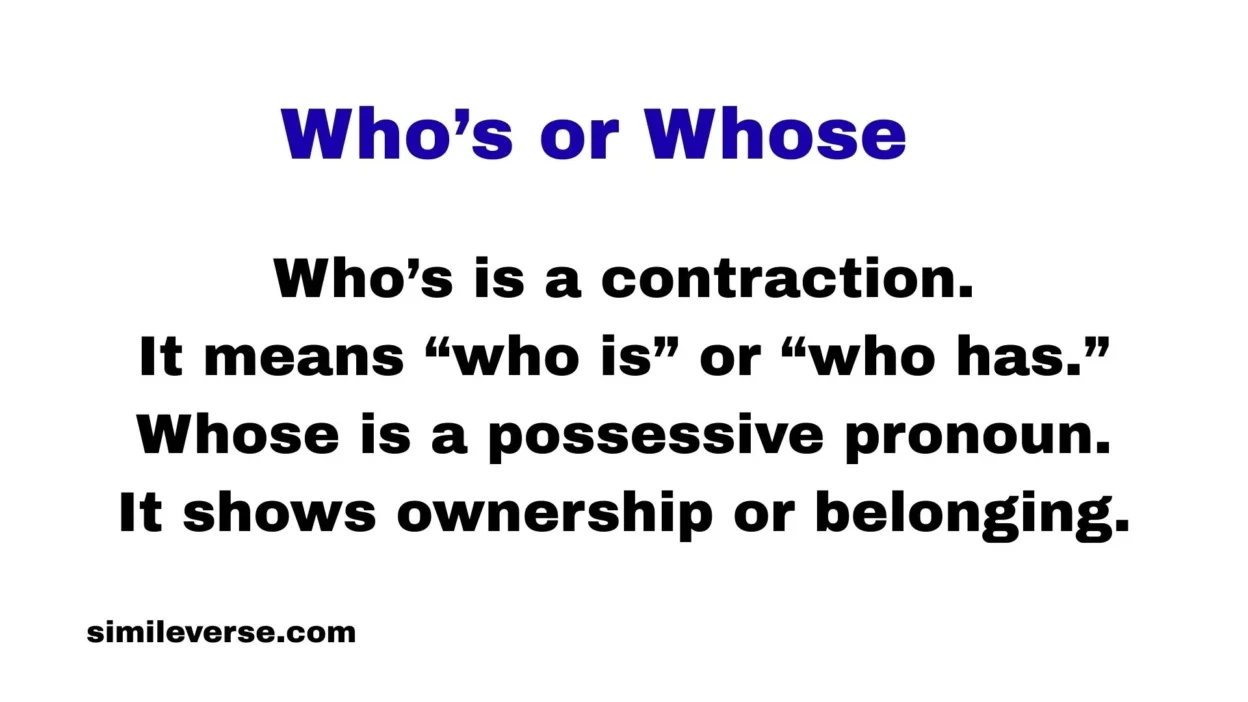
Who’s is a contraction.
It means “who is” or “who has.”
Whose is a possessive pronoun.
It shows ownership or belonging.
Simple Examples
- Who’s coming to the meeting?
(Who is coming?) - Who’s finished the homework?
(Who has finished?) - Whose bag is this?
(The bag belongs to someone.) - She asked whose phone was ringing.
(Ownership is shown.)
Quick tip:
If you can replace the word with “who is” or “who has,” use who’s.
If not, use whose.
The Origin of Who’s or Whose
The confusion between who’s and whose comes from their history and spelling.
Who’s
- Who’s comes from “who is” or “who has.”
- The apostrophe shows that letters are missing.
- This rule comes from standard English contraction patterns used for centuries.
Whose
- Whose comes from the possessive form of “who.”
- Old English used different forms to show possession.
- Over time, whose became the accepted possessive spelling.
Why the Difference Exists
English possessive pronouns do not use apostrophes:
- his
- hers
- its
- whose
This rule often surprises learners, but it explains why whose has no apostrophe.
British English vs American English Spelling
There is no spelling difference between British and American English for who’s and whose. Both follow the same grammar rules.
Examples Used in Both Variants
- Who’s responsible for this report?
- Whose idea was it?
Comparison Table
| Form | Meaning | British English | American English |
|---|---|---|---|
| who’s | who is / who has | Same usage | Same usage |
| whose | shows ownership | Same usage | Same usage |
Unlike words such as colour/color, who’s or whose remains consistent worldwide.
Which Spelling Should You Use?
Your choice depends on meaning, not location.
Use who’s when:
- You mean who is
- You mean who has
Example:
- Who’s ready to start?
Use whose when:
- You show ownership
- You ask about belonging
Example:
- Whose keys are on the table?
Audience-Based Advice
- US audience: Follow standard rules (same usage)
- UK/Commonwealth: Same rules apply
- Global audience: Choose based on meaning, not region
There is no regional preference—only grammatical correctness.
Common Mistakes with Who’s or Whose
Many writers make the same errors again and again.
Mistake 1: Using who’s for ownership
❌ Who’s book is this?
✅ Whose book is this?
Mistake 2: Using whose as a contraction
❌ Whose going to call her?
✅ Who’s going to call her?
Mistake 3: Avoiding both due to fear
❌ Writing awkward sentences to avoid choice
✅ Learn the rule and write confidently
Easy Fix
Always test the sentence with “who is”.
If it works, use who’s.
If not, use whose.
Who’s or Whose in Everyday Examples
Emails
- Who’s available for a quick call?
- Whose approval do we need?
News Writing
- The reporter asked who’s responsible.
- Police are investigating whose vehicle was involved.
Social Media
- Who’s watching this tonight?
- Whose comment made you laugh?
Formal Writing
- The committee will decide who’s eligible.
- The author explains whose theory shaped the study.
Both words appear in all writing levels when used correctly.
Who’s or Whose – Google Trends & Usage Data
Search data shows that “who’s or whose” is commonly searched by:
- Students
- Non-native English learners
- Content writers
- Professionals checking emails
Popular Contexts
- Grammar checks
- School assignments
- Blog writing
- Social media captions
Countries with high interest include:
- United States
- United Kingdom
- Canada
- Australia
- India
This shows a global need for clarity, not a regional spelling issue.
Who’s vs Whose Comparison Table
| Feature | Who’s | Whose |
|---|---|---|
| Word type | Contraction | Possessive pronoun |
| Meaning | Who is / Who has | Belonging or ownership |
| Apostrophe | Yes | No |
| Question use | Yes | Yes |
| Formal writing | Less common | Very common |
FAQs About Who’s or Whose
1. Is who’s ever possessive?
No. Who’s is never possessive. It only means who is or who has.
2. Why doesn’t whose have an apostrophe?
Possessive pronouns do not use apostrophes in English grammar.
3. Can whose refer to things, not people?
Yes.
Example: a company whose profits grew fast.
4. Is who’s informal?
Yes. It is more common in speech and casual writing.
5. Is whose formal?
Yes. Whose is used in both formal and informal writing.
6. Are the rules different in British English?
No. The rules are exactly the same.
7. What is the easiest way to remember the difference?
Replace the word with “who is.” If it works, use who’s.
Conclusion
Understanding who’s or whose is easier than it seems once you know the rule behind each word. Who’s is always a contraction meaning who is or who has, while whose always shows ownership. The confusion happens because English possessive pronouns do not use apostrophes, which feels unnatural to many learners.
There is no difference between British and American English usage, making this rule universal and reliable. Whether you are writing an email, posting online, or working on formal content, choosing the correct form improves clarity and credibility. A quick mental test—replacing the word with “who is”—can instantly guide your choice.
By mastering who’s vs whose, you remove hesitation from your writing and communicate with confidence. Small grammar fixes like this create a big impact on how professional and polished your words appear.