Have you ever stopped while writing an email, post, or article and wondered: is it “truely” or “truly”? You are not alone. This is one of the most searched spelling questions in English. People often feel confused because many English words ending in -ly keep the base spelling, so true → truely seems logical. But English does not always follow logic.
The purpose of this article is to solve this confusion once and for all. If you are a student, teacher, blogger, writer, or professional, choosing the correct spelling matters. A small spelling mistake can change how polished and trustworthy your writing looks.
In this guide, you will get a quick answer, learn why the confusion exists, understand British vs American usage, see real-life examples, explore Google Trends and usage data, and get clear advice on which spelling to use. By the end, you will never hesitate again when choosing between truely and truly.
Truely or Truly – Quick Answer
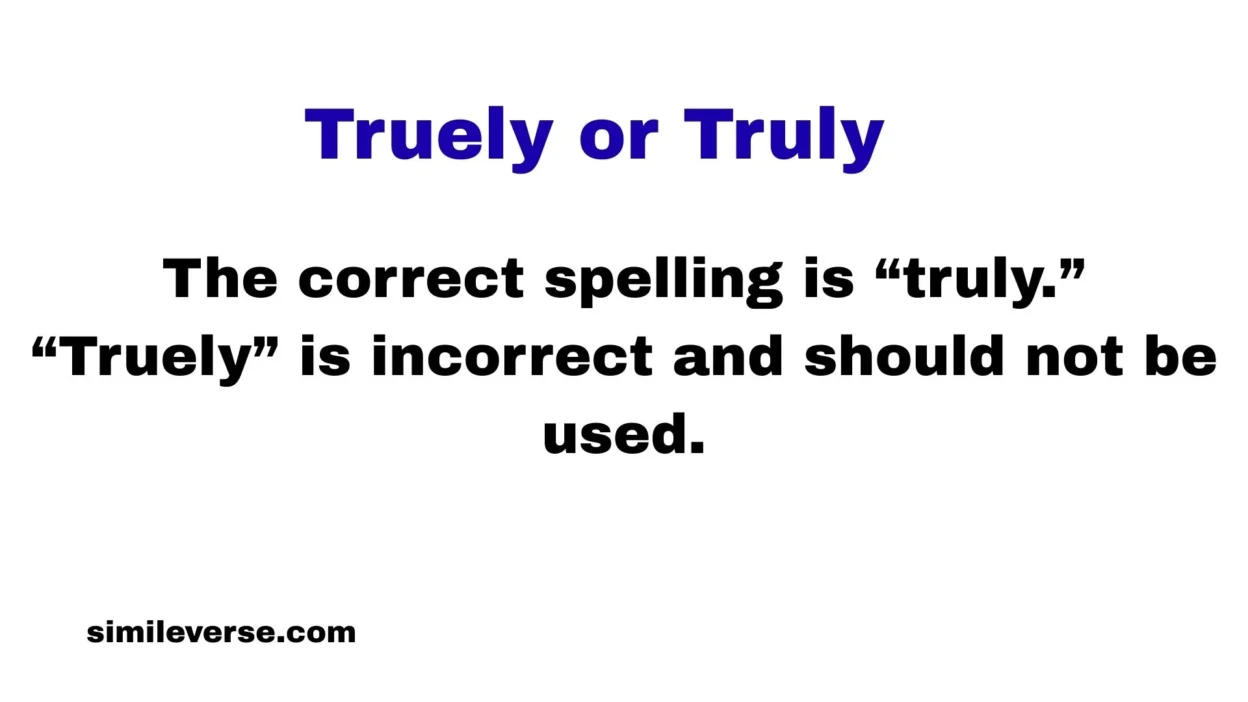
The correct spelling is “truly.”
“Truely” is incorrect and should not be used.
Examples:
- ✅ I truly appreciate your help.
- ❌ I truely appreciate your help.
- ✅ She is truly talented.
- ❌ She is truely talented.
No dictionary, style guide, or grammar authority accepts truely as a correct word.
The Origin of Truely or Truly
The word truly comes from the adjective true. In Old English, true became trēow or trīe, meaning faithful or honest. When English formed adverbs, some words dropped a letter instead of adding -ly normally.
That is what happened here:
- true + ly = truly (the e is dropped)
This spelling change happened for ease of pronunciation. Saying true-ly with the “e” sound felt awkward, so English simplified it.
That is why:
- true → truly
- due → duly
- whole → wholly
Because many words do keep the “e” (like nice → nicely), people naturally assume truely should exist. But historically, it never became standard.
British English vs American English Spelling
Unlike many spelling debates, there is no difference here between British and American English.
Both follow the same rule:
- ✅ Truly (correct)
- ❌ Truely (incorrect)
Comparison Table: British vs American English
| Variant | British English | American English |
|---|---|---|
| truly | ✅ Correct | ✅ Correct |
| truely | ❌ Incorrect | ❌ Incorrect |
So no matter where your audience lives, “truly” is always the right choice.
Which Spelling Should You Use?
Here is clear, audience-based advice:
- US Audience → Use truly
- UK Audience → Use truly
- Canada, Australia, New Zealand → Use truly
- Global or SEO Content → Use truly
There is no situation where truely is acceptable. If you want your writing to look professional, accurate, and trustworthy, always choose truly.
Common Mistakes with Truely or Truly
Many writers make the same errors again and again. Here are the most common ones:
Mistake 1: Adding “-ly” without removing “e”
- Incorrect: truely
- Correct: truly
Mistake 2: Thinking it is a British spelling
- Incorrect: “Truely is used in UK English.”
- Correct: Only truly exists in all English types.
Mistake 3: Using it casually on social media
- Incorrect: I truely love this song.
- Correct: I truly love this song.
Even small mistakes like this can reduce credibility, especially in professional or SEO writing.
Truely or Truly in Everyday Examples
Emails
- ✅ I truly appreciate your quick reply.
- ❌ I truely appreciate your quick reply.
News Writing
- ✅ This is a truly historic moment.
- ❌ This is a truely historic moment.
Social Media
- ✅ I truly enjoyed today’s match!
- ❌ I truely enjoyed today’s match!
Formal Writing
- ✅ She truly understands the issue.
- ❌ She truely understands the issue.
In every context, truly is correct.
Truely or Truly – Google Trends & Usage Data
Search data shows that “truely or truly” is searched thousands of times each month. This tells us two things:
- Many people mistype “truely”
- People want a quick, clear answer
Usage by Context:
- Education & grammar searches → very common
- SEO and blogging → frequent confusion
- Non-native English speakers → high search volume
Popular Regions:
- United States
- United Kingdom
- India
- Pakistan
- Australia
Across all regions, “truly” dominates real usage, while truely appears mainly as a spelling mistake.
Comparison Table: Truely vs Truly
| Feature | Truely | Truly |
|---|---|---|
| Correct spelling | ❌ No | ✅ Yes |
| Dictionary accepted | ❌ No | ✅ Yes |
| Used in British English | ❌ No | ✅ Yes |
| Used in American English | ❌ No | ✅ Yes |
| Safe for SEO & professional writing | ❌ No | ✅ Yes |
FAQs About Truely or Truly
1. Is “truely” ever correct?
No. Truely is never correct in modern English.
2. Why do people spell it as “truely”?
Because most -ly adverbs keep the “e,” which causes confusion.
3. Is “truly” American or British?
It is both American and British.
4. Can I use “truely” in informal writing?
No. Even informal writing should use truly.
5. Do dictionaries accept “truely”?
No major dictionary accepts it.
6. Is “truly” an adverb?
Yes. It modifies verbs, adjectives, and sentences.
7. How can I remember the correct spelling?
Remember: true drops the “e” → truly, just like due → duly.
Conclusion
The confusion between truely or truly is common, but the answer is simple. “Truly” is the only correct spelling. The word comes from true, but English drops the “e” for smoother pronunciation. This rule applies in American English, British English, and all global forms of English.
Using truely is always a spelling mistake. It can hurt your writing, SEO rankings, and professional image. If you are writing an email, a school assignment, a blog post, or formal content, choosing truly shows clarity and confidence.
If you remember just one thing, remember this:
If you mean honestly, deeply, or sincerely, the word is truly.
No exceptions. No alternatives. Just truly.