Have you ever paused mid-sentence, wondering whether to write traveled or travelled? You’re not alone. This is one of the most common spelling questions in English, especially for writers, students, bloggers, and professionals who communicate with an international audience. Both spellings look correct, sound the same, and even mean the same thing—so why the confusion?
People search for “traveled or travelled” because English spelling changes depending on location. American English and British English follow different spelling rules, and this word sits right in the middle of that divide. If you use the wrong version for your audience, your writing can look inconsistent or unpolished, even if your message is clear.
This article solves that confusion once and for all. You’ll get a quick answer, learn where the spellings came from, see how British and American English differ, and understand which version you should use based on your audience. We’ll also cover common mistakes, real-life examples, usage trends, and FAQs—so you can use traveled or travelled with total confidence.
Traveled or Travelled – Quick Answer
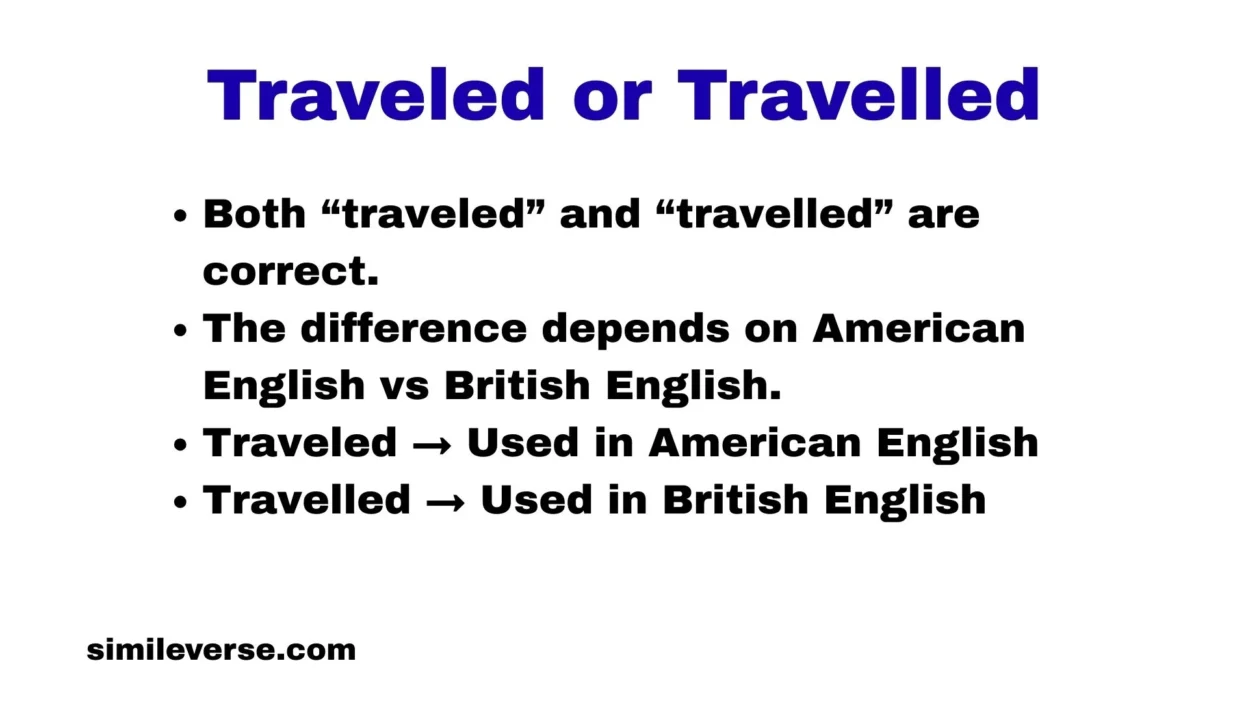
Both “traveled” and “travelled” are correct.
The difference depends on American English vs British English.
- Traveled → Used in American English
- Travelled → Used in British English
Examples:
- 🇺🇸 She traveled across the U.S. last summer.
- 🇬🇧 She travelled across Europe last summer.
Same meaning. Same pronunciation. Different spelling rules.
The Origin of Traveled or Travelled
The verb travel comes from the Old French word travailler, meaning “to toil” or “to journey with effort.” Over time, it entered Middle English as travail and later became travel.
The spelling split happened much later. In the 1800s, American English—largely influenced by Noah Webster—began simplifying spellings. One major change was dropping extra letters, especially double consonants.
British English kept the traditional forms, including double L in words like:
- travelled
- cancelled
- labelled
American English simplified them to:
- traveled
- canceled
- labeled
That’s why both spellings exist today.
British English vs American English Spelling
The key rule involves doubling the final consonant when adding -ed or -ing.
The Rule Explained (Simply)
- British English often doubles the L
- American English usually does not
Examples
| British English | American English |
|---|---|
| travelled | traveled |
| travelling | traveling |
| cancelled | canceled |
| labelled | labeled |
Comparison Table: Traveled vs Travelled
| Feature | Traveled | Travelled |
|---|---|---|
| English Variant | American | British |
| Region | USA | UK, Canada, Australia |
| Considered Correct? | Yes | Yes |
| Meaning | Past tense of travel | Past tense of travel |
Which Spelling Should You Use?
It depends on who you are writing for.
Use Traveled if:
- Your audience is in the United States
- You follow American English style guides
- You write for U.S.-based blogs, schools, or businesses
Use Travelled if:
- Your audience is in the UK
- You write for Canada, Australia, or New Zealand
- You follow British English standards
Writing for a Global Audience?
Pick one style and stay consistent. Consistency matters more than the choice itself.
Common Mistakes with Traveled or Travelled
Here are frequent errors and how to fix them:
❌ She has travaled a lot.
✅ She has traveled a lot.
❌ He travelled to New York (American document)
✅ He traveled to New York
❌ Mixing styles in one text
✅ Stick to one spelling style
The biggest mistake is inconsistency, not the spelling itself.
Traveled or Travelled in Everyday Examples
Emails
- I traveled for work last week. (US)
- I travelled for work last week. (UK)
News
- The president traveled overseas for talks.
- The minister travelled abroad for meetings.
Social Media
- I’ve traveled to five countries this year!
- Just travelled back home—miss it already.
Formal Writing
- The researcher traveled extensively for fieldwork.
- The author travelled throughout Europe.
Traveled or Travelled – Google Trends & Usage Data
Search trends show clear regional patterns:
- Traveled is searched more in the United States
- Travelled dominates searches in the UK and Commonwealth countries
- Globally, both spellings are widely accepted
In professional and SEO writing, Google understands both spellings, but matching your audience’s regional preference improves clarity and trust.
Keyword Variations Comparison Table
| Form | American English | British English |
|---|---|---|
| Past tense | traveled | travelled |
| Present participle | traveling | travelling |
| Base verb | travel | travel |
FAQs: Traveled or Travelled
1. Is “travelled” wrong in American English?
No, but it looks British. Americans prefer “traveled.”
2. Is “traveled” incorrect in the UK?
No, but “travelled” is standard British spelling.
3. Which spelling is better for SEO?
Use the version your target audience searches for.
4. Can I use both spellings in one article?
Not recommended. Stay consistent.
5. Are traveled and travelled pronounced differently?
No. They sound exactly the same.
6. Does Google accept both spellings?
Yes. Google recognizes both as correct.
7. Which spelling should students use?
Follow your school’s English style guide.
Conclusion
The confusion between traveled or travelled comes down to regional spelling rules—not correctness. Both forms are grammatically correct, widely accepted, and mean the same thing. The real key is knowing your audience and staying consistent with the English variant you choose.
If you write for an American audience, traveled is the natural choice. If your readers are in the UK or Commonwealth countries, travelled fits better. For global writing, consistency matters more than the spelling itself.
Understanding this small difference can instantly improve your writing’s clarity and professionalism. Now that you know the rule, you’ll never hesitate again when choosing between traveled and travelled.