“Too or to” is one of the most searched grammar questions online—and for good reason. These two tiny words look similar, sound almost the same, and are used every day in emails, messages, schoolwork, and social media. Yet they have very different meanings. A single mistake can change the meaning of a sentence or make your writing look careless. That’s why people often stop mid-sentence and ask themselves: Is it too or to?
The confusion usually comes from pronunciation. In normal speech, too and to often sound identical. But in writing, they play completely different roles. One shows direction or purpose, while the other shows extra, excess, or agreement. Mixing them up is one of the most common English errors for students, professionals, and even native speakers.
This article solves that confusion once and for all. You’ll get a quick answer, simple rules, real-life examples, common mistakes, and clear advice on which spelling to use and when. By the end, you’ll confidently choose too or to—every single time.
Too or To – Quick Answer
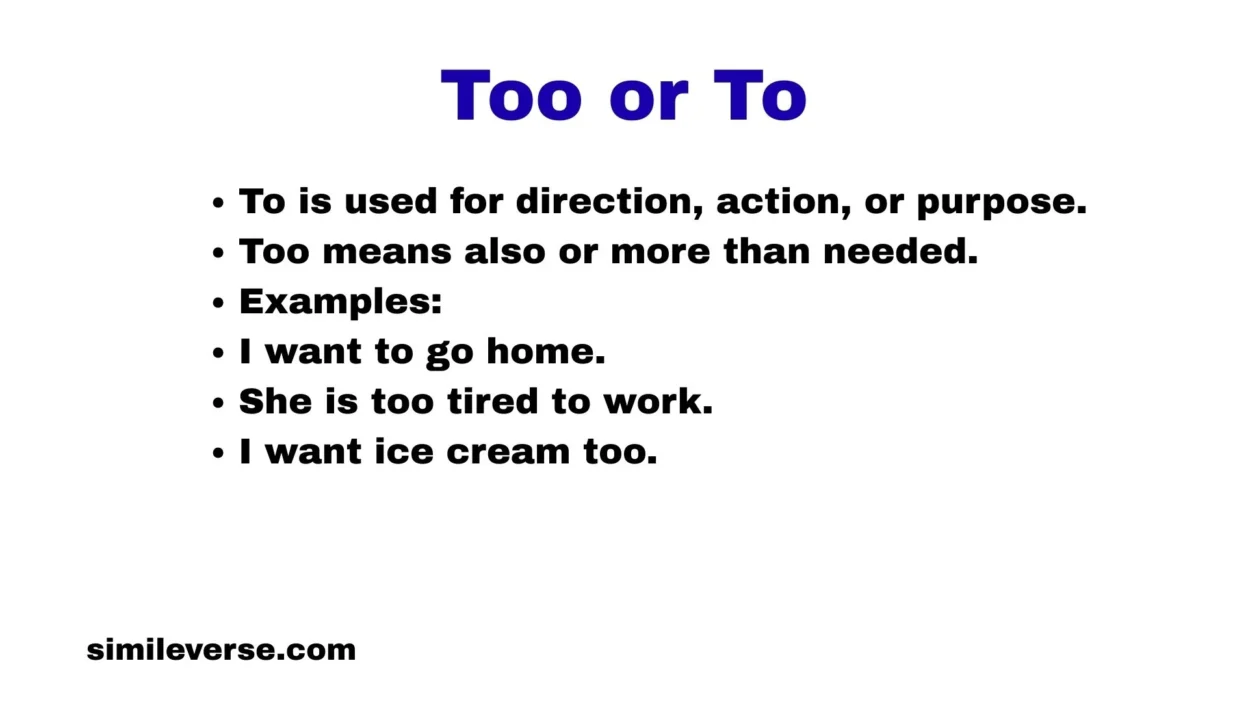
To is used for direction, action, or purpose.
Too means also or more than needed.
Examples:
- I want to go home.
- She is too tired to work.
- I want ice cream too.
Quick tip:
If you can replace the word with “also” or “very,” use too. Otherwise, use to.
The Origin of Too or To
The word to comes from Old English tō, meaning toward or in the direction of. It has always been a helper word used before verbs (to eat, to run) or to show movement (go to school).
The word too comes from Old English tō, meaning in addition or excessively. Over time, English added an extra “o” to separate its meaning from to.
So, the spelling difference exists to make reading clearer—even if speaking still sounds the same.
British English vs American English Spelling
There is no spelling difference between British and American English for too or to. Both follow the same rules.
Comparison Table
| Usage Purpose | Correct Word | Example |
|---|---|---|
| Direction | to | Go to the market |
| Action | to | Want to learn |
| Also | too | I like it too |
| Excess | too | Too loud |
Which Spelling Should You Use?
- US audience: Use standard rules (to = action, too = extra/also)
- UK & Commonwealth: Same rules apply
- Global audience: Use to and too correctly for clarity and trust
There is no regional preference. Correct usage matters more than location.
Common Mistakes with Too or To
❌ I am going too school
✅ I am going to school
❌ This bag is to heavy
✅ This bag is too heavy
I want too eat
I want to eat
Why mistakes happen:
Because both words sound the same when spoken.
Too or To in Everyday Examples
Emails
- Please send the file to me.
- I am happy too help.
News
- The price is too high for buyers.
- Leaders met to discuss plans.
Social Media
- I want to travel!
- That movie was great too!
Formal Writing
- This issue is too important to ignore.
- We aim to improve results.
Too or To – Google Trends & Usage Data
Search data shows “too or to” is most searched in:
- United States
- United Kingdom
- India
- Pakistan
- Australia
The keyword is popular in:
- School homework searches
- Grammar checks
- Email and writing help
This shows people want quick answers and simple rules, not complex grammar terms.
Comparison Table: Too vs To
| Word | Meaning | Replace Test | Example |
|---|---|---|---|
| to | Direction or action | Cannot replace | Go to work |
| too | Also / excess | Replace with “also” | Me too |
FAQs: Too or To
1. Is “too” ever used before a verb?
Yes. Example: She is too tired to move.
2. Can “to” mean also?
No. Only too means also.
3. Is “too much” correct?
Yes. “Too much” shows excess.
4. Why do people confuse too or to?
Because they sound the same when spoken.
5. Is one more formal than the other?
No. Both are normal English words.
6. Can Grammarly catch this mistake?
Yes, but learning the rule is better.
7. Is “to” always followed by a verb?
Often, but not always. Example: Go to bed.
Conclusion
Choosing between too or to does not have to be confusing. The key is understanding their purpose. To is used for direction, movement, or action. Too is used to show excess or to mean also.
Even though they sound the same, their meanings are very different, and using the wrong one can change your sentence or make your writing look unprofessional.
If you remember one simple trick—replace the word with “also” or “very”—you’ll know when to use too. If that doesn’t work, to is usually the right choice. This rule works in emails, school work, social posts, and formal writing.
Mastering small grammar rules like this improves clarity, confidence, and credibility. Now that you know the difference, you’ll never hesitate again when choosing too or to.