Tom Brady’s career stats tell one of the most remarkable stories in sports history. Over more than two decades in the NFL, Brady transformed from a sixth-round draft pick into the most accomplished quarterback the league has ever seen.
His numbers are not just impressive totals—they represent unmatched consistency, longevity, and winning at the highest level.
From record-breaking passing yards and touchdowns to dominant playoff and Super Bowl performances, Brady set a standard that few players have ever approached.
What makes Tom Brady’s career statistics truly special is how they span multiple eras of football. He excelled in different offensive systems, adapted to rule changes, and continued producing elite numbers well into his 40s.
If with the New England Patriots or the Tampa Bay Buccaneers, Brady’s impact showed up every season on the stat sheet and in the win column.
In this article, we take an in-depth look at Tom Brady’s career stats, breaking down the numbers, milestones, and records that define his legacy as the greatest quarterback of all time.
Early Life and Path to the NFL
Tom Brady’s journey to becoming an NFL legend began long before his record-breaking career stats took shape. Born on August 3, 1977, in San Mateo, California, Brady grew up in a sports-loving family and developed a passion for football at a young age. He attended Junípero Serra High School, where he played quarterback and showed flashes of leadership, though he was not widely viewed as an elite prospect. Brady split time as a starter and often had to compete for playing opportunities, an early challenge that helped shape his resilience and work ethic.
Brady went on to play college football at the University of Michigan, where his path was anything but smooth. He spent much of his early college career as a backup and famously battled for the starting quarterback role. Despite limited early playing time, Brady made the most of his opportunities, finishing his Michigan career with strong performances, including memorable comeback wins. However, his college stats and lack of elite physical traits caused many NFL teams to overlook him.
In the 2000 NFL Draft, Tom Brady was selected in the sixth round as the 199th overall pick by the New England Patriots. Expectations were minimal, and few could have predicted what was to come. That draft position would later become one of the most famous stories in sports history. Brady entered the league as an underdog, but his intelligence, discipline, and competitive mindset laid the foundation for a career that would redefine what greatness looks like in the NFL.
NFL Career Timeline
Tom Brady’s NFL career timeline is a story of growth, dominance, and historic longevity. After being drafted by the New England Patriots in 2000, Brady spent his rookie season as a backup, learning the system and refining his skills. His career changed dramatically in 2001 when he stepped in as the starting quarterback due to an injury to Drew Bledsoe. That season ended with Brady leading the Patriots to a Super Bowl victory, marking the beginning of one of the greatest dynasties in sports history.
From 2001 to 2019, Brady served as the face of the New England Patriots. During this period, he led the team to multiple Super Bowl championships, consistently posting elite regular-season and playoff stats. Year after year, Brady adapted to new teammates, evolving offenses, and league changes, yet his production remained among the best in the NFL. His ability to perform under pressure became a defining trait, especially during deep playoff runs and championship games.
In 2020, Brady made a surprising move by signing with the Tampa Bay Buccaneers. Many questioned whether he could succeed outside of New England, but he quickly silenced critics. In his first season with Tampa Bay, Brady led the Buccaneers to a Super Bowl title, adding another remarkable chapter to his career timeline. He continued to put up strong passing numbers until his retirement after the 2022 season.
Across 23 NFL seasons, Tom Brady’s career timeline reflects sustained excellence, adaptability, and an unmatched commitment to winning. Each phase of his career contributed to the legendary stats and records that define his place in NFL history.
Career Games and Longevity Stats
One of the most extraordinary aspects of Tom Brady’s career stats is his unmatched longevity in the NFL. Over the course of 23 seasons, Brady played in more games than any other quarterback in league history, a testament to his durability, preparation, and commitment to physical conditioning. At a position known for heavy contact and short career spans, Brady consistently defied expectations year after year.
Tom Brady appeared in over 330 regular-season games, starting the vast majority of them. When playoff games are included, his total game appearances climb even higher, setting records that may never be broken. His ability to stay on the field for so long allowed him to accumulate historic passing totals and maintain a high level of performance well into his 40s. Few quarterbacks have remained starters past age 35, yet Brady continued producing elite numbers past age 40, something unprecedented in NFL history.
Brady’s longevity was not just about playing longer—it was about staying effective. Even in the later stages of his career, he ranked among league leaders in passing yards, touchdowns, and attempts. His dedication to training, recovery, and nutrition played a major role in extending his career, helping him avoid serious injuries after his early years.
Another key factor in Brady’s longevity stats is consistency. He rarely missed games and was known for his reliability as a starter. This sustained availability gave his teams stability and leadership over decades. When examining Tom Brady’s career games and longevity stats, it becomes clear that his endurance and durability are just as impressive as his championships and records, further strengthening his case as the greatest quarterback of all time.
Regular Season Career Stats
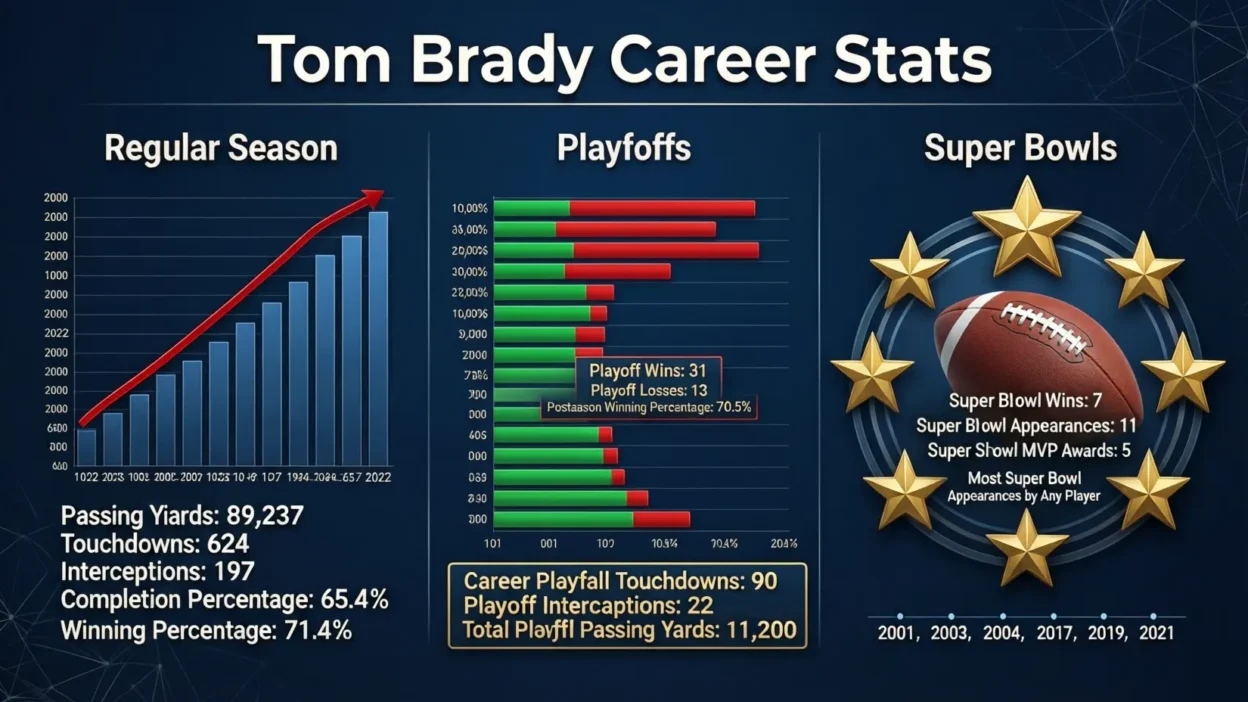
Tom Brady’s regular season career stats form the foundation of his legendary NFL résumé. Across 23 seasons, Brady consistently produced elite passing numbers, setting records that reflect both volume and efficiency. He finished his career as the NFL’s all-time leader in passing yards and passing touchdowns, milestones achieved through sustained excellence rather than short-term peaks. These regular season totals highlight just how dominant and reliable he was year after year.
Brady completed thousands of passes during his career, maintaining a strong completion percentage despite playing in different offensive systems and eras. His ability to read defenses, make quick decisions, and deliver accurate throws allowed him to remain productive even as the league evolved. Season after season, Brady ranked among the league leaders in attempts and completions, showing the trust his coaches placed in him as the focal point of their offenses.
Touchdowns were another defining part of Brady’s regular season stats. He recorded multiple seasons with 30 or more passing touchdowns and had several years where he led the NFL in touchdown passes. Even as he aged, his red-zone efficiency remained elite, proving that experience and football intelligence could offset any decline in physical ability.
While interceptions are a part of any quarterback’s career, Brady managed risk better than most. His interception totals were consistently low relative to his pass attempts, highlighting his disciplined approach to the game. When looking at Tom Brady’s regular season career stats as a whole, the numbers tell a story of consistency, durability, and elite-level production that few quarterbacks in NFL history can match.
Career Averages and Per-Game Stats
Tom Brady’s career averages and per-game stats offer deeper insight into just how consistently elite he was throughout his time in the NFL. While his career totals are staggering, his per-game numbers reveal that his production remained strong across different teams, systems, and stages of his career. On average, Brady threw for well over 260 passing yards per game, a figure that places him among the most productive quarterbacks in league history.
Brady’s touchdowns-per-game average further highlights his sustained effectiveness. Across more than two decades, he consistently averaged close to two passing touchdowns per game, even while facing some of the league’s toughest defenses. This steady scoring output played a major role in his teams’ offensive success and ability to control games. At the same time, his interceptions-per-game average stayed relatively low, reflecting his careful decision-making and situational awareness.
Completion percentage is another key area where Brady’s per-game efficiency stands out. His career completion rate remained in the mid-60 percent range, impressive given the high volume of attempts and the evolving defensive schemes he faced. Brady’s ability to maintain accuracy while throwing the ball as often as he did is a strong indicator of his technical skill and football intelligence.
When comparing Brady’s per-game stats to league averages during his career, he consistently ranked above most of his peers. Even in seasons where his teams leaned on the running game or defense, Brady’s per-game production remained reliable. These career averages show that Tom Brady was not just a quarterback who accumulated stats over time, but one who delivered elite performance on a game-by-game basis for more than 20 seasons.
Playoff Career Stats
Tom Brady’s playoff career stats are a major reason why he is widely considered the greatest quarterback in NFL history. While many players see a drop in performance under postseason pressure, Brady consistently elevated his play when the stakes were highest. Over his career, he made more playoff appearances and started more postseason games than any other quarterback, giving him an unmatched sample size of elite performances.
Brady finished his career with the most playoff wins by a quarterback, a record that reflects both his individual excellence and his ability to lead teams deep into the postseason year after year. He also holds the record for most playoff passing yards and playoff passing touchdowns, numbers that are far ahead of any other player in NFL history. These stats highlight not only longevity but sustained dominance against the league’s best defenses.
In playoff games, Brady was known for his poise and decision-making. His completion percentage and touchdown totals remained strong, even as defenses became more aggressive and game plans more complex. Brady also engineered numerous postseason comebacks, often leading game-winning drives in critical moments. His calm presence in high-pressure situations became a defining characteristic of his playoff legacy.
Another key element of Brady’s playoff stats is consistency. Whether playing at home in Foxborough, on the road, or in the Super Bowl, his performance rarely wavered. When analyzing Tom Brady’s playoff career stats, it becomes clear that his greatness was not limited to the regular season. Instead, his postseason numbers confirm that he was at his best when championships were on the line.
Super Bowl Career Stats
Tom Brady’s Super Bowl career stats are unparalleled in NFL history and solidify his legacy as the most successful quarterback of all time. Across ten Super Bowl appearances, Brady won seven championships, more than any single franchise quarterback in NFL history. His ability to perform at the highest level on football’s biggest stage is reflected not only in his wins but in the numbers he put up in each game.
Brady’s Super Bowl passing yards total exceeds 3,000, a record that demonstrates both volume and consistency in the league’s most high-pressure games. He threw 21 passing touchdowns in Super Bowls, with relatively few interceptions, underscoring his efficiency when it mattered most. In addition, his completion percentage in Super Bowls remained high, highlighting his accuracy under the intense pressure of championship football.
Brady also earned five Super Bowl MVP awards, more than any other player in NFL history. These accolades were the result of games in which he not only produced exceptional statistics but also led dramatic comebacks and game-winning drives. Notable examples include Super Bowl LI against the Atlanta Falcons, where Brady engineered the largest comeback in Super Bowl history, and Super Bowl LV, where he led the Tampa Bay Buccaneers to a dominant win.
Beyond individual numbers, Brady’s Super Bowl stats reflect his leadership and ability to elevate teammates. He consistently maximized the potential of his offense, turning every opportunity into a chance for a championship. When evaluating Tom Brady’s Super Bowl career stats, it is clear that his performances on football’s biggest stage are unmatched, making him the ultimate postseason competitor and a true NFL legend.
Season-by-Season Statistical Highlights
Tom Brady’s season-by-season statistical highlights showcase his sustained excellence and ability to adapt across more than two decades in the NFL. Each season contributed to his legacy, with certain years standing out as historic benchmarks that illustrate both his dominance and consistency. From his first full season as a starter in 2001 to his final years with the Tampa Bay Buccaneers, Brady’s performance remained elite.
One of Brady’s most remarkable seasons came in 2007, when he set the single-season record for passing touchdowns with 50 and threw for over 4,800 passing yards. That season, he led the New England Patriots to an undefeated regular season, cementing his place among the NFL’s elite. Other notable seasons include 2010, where he threw for 36 touchdowns, and 2011, when he passed for over 5,000 yards, demonstrating his consistency and ability to push the limits of offensive production.
Brady’s late-career seasons also highlight his adaptability. With Tampa Bay, even in his 40s, he consistently ranked among the league leaders in passing yards and touchdowns. For example, in 2020, he threw for over 4,600 yards and 40 touchdowns, leading the Buccaneers to a Super Bowl victory. These stats demonstrate that Brady’s performance did not decline significantly with age, a rarity for NFL quarterbacks.
Other statistical highlights include multiple seasons leading the league in completion percentage, passer rating, and touchdown-to-interception ratio. Examining Tom Brady’s season-by-season stats shows a quarterback who combined peak performance with unmatched consistency, making his career a model of sustained excellence and a benchmark for future generations.
Career Awards and Honors
Tom Brady’s career awards and honors reflect his dominance, consistency, and influence on the NFL over more than two decades. Throughout his career, he accumulated an unprecedented number of accolades that showcase both his individual talent and his ability to lead teams to victory. These awards not only highlight his statistical achievements but also recognize his impact on games and championships.
Brady was named NFL Most Valuable Player (MVP) three times—in 2007, 2010, and 2017. These awards came during seasons when he led the league in passing yards, touchdowns, or both, demonstrating his ability to maintain elite performance over time. In addition to MVP honors, he earned five Super Bowl MVP awards, more than any other player in history. These awards emphasize Brady’s ability to perform at the highest level during the most critical games of his career.
Brady was also selected to the Pro Bowl 15 times, reflecting recognition from coaches, players, and fans for his consistently high-level play. Furthermore, he was named First-Team All-Pro three times, an honor reserved for the league’s very best players at each position. These selections highlight his dominance relative to peers during both the regular season and crucial stretches of the NFL calendar.
Other honors include being named to the NFL 2000s and 2010s All-Decade Teams, reflecting his influence over two distinct decades of football. Collectively, Tom Brady’s awards and honors complement his statistical achievements, illustrating that he was not only productive but also recognized as one of the most impactful players of all time. His accolades reinforce his legacy as the greatest quarterback in NFL history.
All-Time NFL Records Held by Tom Brady
Tom Brady’s career is defined not only by longevity and consistency but also by the historic NFL records he set along the way. His ability to perform at an elite level over more than two decades allowed him to surpass benchmarks that once seemed untouchable. These records reflect both his statistical dominance and his sustained excellence as a quarterback.
Brady is the all-time leader in career passing yards, with over 89,000 yards, a milestone no other quarterback has reached. He also holds the record for career passing touchdowns, with 649, demonstrating his ability to consistently generate scoring opportunities for his teams. In addition, Brady leads all quarterbacks in career wins as a starter, with 251 victories, showcasing not just individual performance but his direct impact on team success.
In the postseason, Brady holds records for most playoff games won, most playoff passing yards, and most playoff passing touchdowns, further distinguishing himself from other quarterbacks. His ten Super Bowl appearances and seven championships remain unmatched, highlighting his ability to excel under pressure on the sport’s biggest stage.
Other notable records include most game-winning drives in the fourth quarter and most comeback victories, which emphasize his clutch performance and leadership in critical moments. He also ranks first in career passing attempts and completions, reflecting his reliability and durability.
These all-time records solidify Tom Brady’s place as the NFL’s statistical and historical benchmark. His combination of skill, leadership, and longevity created a career that not only set records but also redefined what is possible for a quarterback in professional football.
Comparison With Other Legendary Quarterbacks
Tom Brady’s career stats become even more impressive when compared with other legendary quarterbacks of his era. While many quarterbacks have posted remarkable numbers, Brady’s combination of longevity, postseason success, and consistency sets him apart. Comparing him to other all-time greats like Peyton Manning, Drew Brees, and Aaron Rodgers highlights both his statistical dominance and his impact on winning.
When compared to Peyton Manning, Brady holds a clear edge in postseason performance and Super Bowl victories, with Manning earning two championships versus Brady’s seven. While Manning threw for comparable or higher single-season yardage totals, Brady’s sustained success over decades, particularly in high-pressure playoff games, gives him an unmatched advantage.
Against Drew Brees, who holds many career passing records like completions and passing yards, Brady still surpasses him in touchdowns, wins, and championships. Brees excelled in regular-season production, but Brady’s ability to translate stats into team success, especially in the playoffs, differentiates him.
Compared to Aaron Rodgers, known for efficiency and passer rating, Brady ranks slightly behind in single-season efficiency metrics but far ahead in career longevity, total wins, and playoff performance. Rodgers’ career showcases brilliance over a shorter span, while Brady maintained elite production for more than 20 years.
Ultimately, statistical comparisons show that while other quarterbacks have excelled in specific areas, Tom Brady’s unique combination of volume, efficiency, clutch performance, and championship success is unmatched. These comparisons reinforce why Brady is widely regarded not just as one of the greatest quarterbacks, but as the GOAT of the NFL era.
Advanced Analytics and Modern Metrics
Beyond traditional statistics, advanced analytics and modern metrics further highlight Tom Brady’s greatness as a quarterback. While passing yards, touchdowns, and wins are important, metrics such as Expected Points Added (EPA), Win Probability Added (WPA), and adjusted net yards per attempt (ANY/A) provide deeper insight into Brady’s impact on each game and his overall efficiency.
In terms of EPA, which measures the value a player adds to his team’s expected points on each play, Brady consistently ranks near the top of all quarterbacks, even late into his 40s. This demonstrates that his contributions were not only about raw numbers but also about generating meaningful results in high-leverage situations. Win Probability Added further emphasizes Brady’s ability to perform in critical moments, particularly in the fourth quarter or during playoff games. He consistently increased his team’s chances of winning more than any other quarterback in history, showcasing his clutch performance.
Adjusted metrics like ANY/A reveal Brady’s efficiency regardless of attempts or situations. Despite being a high-volume passer, his adjusted net yards per attempt remained elite, reflecting his accuracy, decision-making, and ability to maximize yards while minimizing turnovers. These metrics also highlight his adaptability to different offensive systems, teammates, and eras.
Advanced analytics confirm what traditional stats already suggest: Brady’s impact was both measurable and extraordinary. He was not only durable and productive but also strategically effective, capable of influencing game outcomes in ways few quarterbacks in history could. By combining traditional stats with advanced metrics, Tom Brady’s career can be appreciated as a model of efficiency, intelligence, and sustained dominance in the NFL.
Team Impact and Winning Influence
Tom Brady’s career stats go far beyond personal achievements; they also reflect his profound impact on team success. One of the clearest indicators of his influence is the win percentage as a starter. Over 23 seasons, Brady’s teams consistently posted winning records, and he holds the record for the most career wins by a quarterback. This demonstrates that his presence on the field directly translated into victories, making him an invaluable asset to every team he played for.
Brady’s leadership elevated the performance of those around him. With the New England Patriots, he helped transform offensive units into perennial playoff contenders. Receivers, tight ends, and running backs often posted career-best numbers under his guidance. When he joined the Tampa Bay Buccaneers, Brady immediately turned a talented but underperforming offense into a Super Bowl-winning machine. His ability to maximize teammates’ potential was as crucial as his own statistical production.
Beyond individual players, Brady’s influence on team dynamics was evident in offensive rankings. Teams with Brady frequently finished at or near the top of the league in points per game, total yards, and red-zone efficiency. His preparation, football IQ, and game-management skills allowed coaches to implement complex game plans with confidence, knowing Brady could execute under pressure.
Clutch performance further enhanced team success. Brady engineered numerous fourth-quarter comebacks and game-winning drives, often turning potential losses into wins. His presence on the roster increased team morale and confidence, giving teammates a psychological edge. When evaluating Tom Brady’s career, it is clear that his impact extended far beyond personal stats—he was a decisive factor in his teams’ sustained success and championship runs.
Leadership, Clutch Factor, and Intangibles
Tom Brady’s career stats are remarkable, but numbers alone cannot capture his true value as a quarterback. One of the defining elements of his greatness was his leadership. From the locker room to the practice field, Brady set a standard for preparation, discipline, and work ethic. Teammates and coaches frequently credited him with raising the performance of everyone around him, proving that his impact extended beyond physical skill.
Another crucial component of Brady’s legacy is his clutch factor. He consistently performed at his best in high-pressure situations, particularly in the fourth quarter or during the postseason. Brady holds the record for most game-winning drives in NFL history, with numerous instances where he led his team from behind to secure victory. These moments not only contributed to his career win totals but also solidified his reputation as the ultimate quarterback in pressure situations.
Brady’s intangibles also included football intelligence and adaptability. He read defenses at an advanced level, adjusted plays at the line of scrimmage, and exploited weaknesses with precision. His ability to quickly process information and make accurate throws under duress was unmatched, allowing him to sustain elite performance even as he aged.
Finally, Brady’s mental toughness and competitiveness defined his career. He thrived in critical games, including Super Bowls and playoff matchups, where the stakes were highest. While statistics showcase his production, these intangibles—leadership, clutch performance, intelligence, and resilience—explain why Tom Brady’s legacy goes far beyond numbers, making him the most complete quarterback in NFL history.
FAQs
1. How many career passing yards does Tom Brady have?
Tom Brady retired with over 89,000 passing yards, the most in NFL history. This total reflects his longevity and consistent production over 23 seasons. His ability to maintain high yardage totals into his 40s contributed significantly to this record.
2. How many passing touchdowns did Tom Brady throw in his career?
Brady threw 649 career passing touchdowns, making him the all-time leader among NFL quarterbacks. These touchdowns came during both the regular season and postseason, illustrating his scoring efficiency and consistency.
3. How many Super Bowls did Tom Brady win?
Tom Brady won seven Super Bowls, the most by any player in NFL history. He appeared in ten Super Bowls, showcasing his ability to lead teams to the highest level of success.
4. What records does Tom Brady hold?
Brady holds numerous NFL records, including career passing yards, career passing touchdowns, career wins as a starting quarterback, most playoff wins, most Super Bowl appearances, and most Super Bowl MVP awards. Many of these records highlight his longevity, consistency, and performance under pressure.
5. How did Tom Brady perform in the playoffs?
Brady excelled in the postseason, holding records for most playoff wins, most playoff passing yards, and most playoff passing touchdowns. He consistently delivered in critical games and engineered multiple comeback victories, earning him a reputation as the ultimate clutch quarterback.
6. Did Tom Brady maintain high performance after age 40?
Yes. Brady remained elite well into his 40s, ranking among league leaders in passing yards, touchdowns, and efficiency metrics. His late-career success, including a Super Bowl win with the Buccaneers, demonstrates unmatched longevity in NFL history.
Conclusion:
Tom Brady’s career stats tell a story few athletes in any sport can match. From his humble beginnings as a sixth-round draft pick to becoming the most decorated quarterback in NFL history, his numbers reflect both extraordinary talent and unparalleled longevity.
Over 23 seasons, Brady accumulated over 89,000 passing yards, 649 passing touchdowns, and the most wins by a starting quarterback, achievements that highlight his consistency, durability, and elite-level production.
What sets Brady apart from other great quarterbacks is not just his volume of stats, but his performance in critical moments.
His playoff and Super Bowl numbers are unmatched: ten Super Bowl appearances, seven championships, five Super Bowl MVP awards, and countless game-winning drives.
These accomplishments demonstrate his ability to elevate his game when the stakes were highest, solidifying his reputation as the ultimate clutch performer.
Beyond the numbers, Brady’s impact on his teams was profound. His leadership, football intelligence, and work ethic elevated teammates and created winning cultures in both New England and Tampa Bay.
Advanced metrics, including Expected Points Added (EPA) and Win Probability Added (WPA), further confirm his strategic impact on every game, showing that his contributions went far beyond passing yards and touchdowns.