Moral of confusion solved: Many people struggle with “quite” vs. “quiet” because they sound similar but mean very different things. This guide will clear the confusion completely.
English learners, writers, and even native speakers often mix up “quite” and “quiet.” This happens because both words sound almost alike, but they serve very different purposes in a sentence. “Quite” is usually used to add emphasis, while “quiet” refers to low noise or calmness.
People search for “quite or quiet” online to quickly understand the difference, avoid embarrassing mistakes in writing, or improve professional communication. Whether you are sending an email, posting on social media, or writing an essay, knowing which word to use is essential.
In this guide, we will explain the difference, origin, spelling, common mistakes, and real-world examples so you never get confused again.
Quite or Quiet – Quick Answer
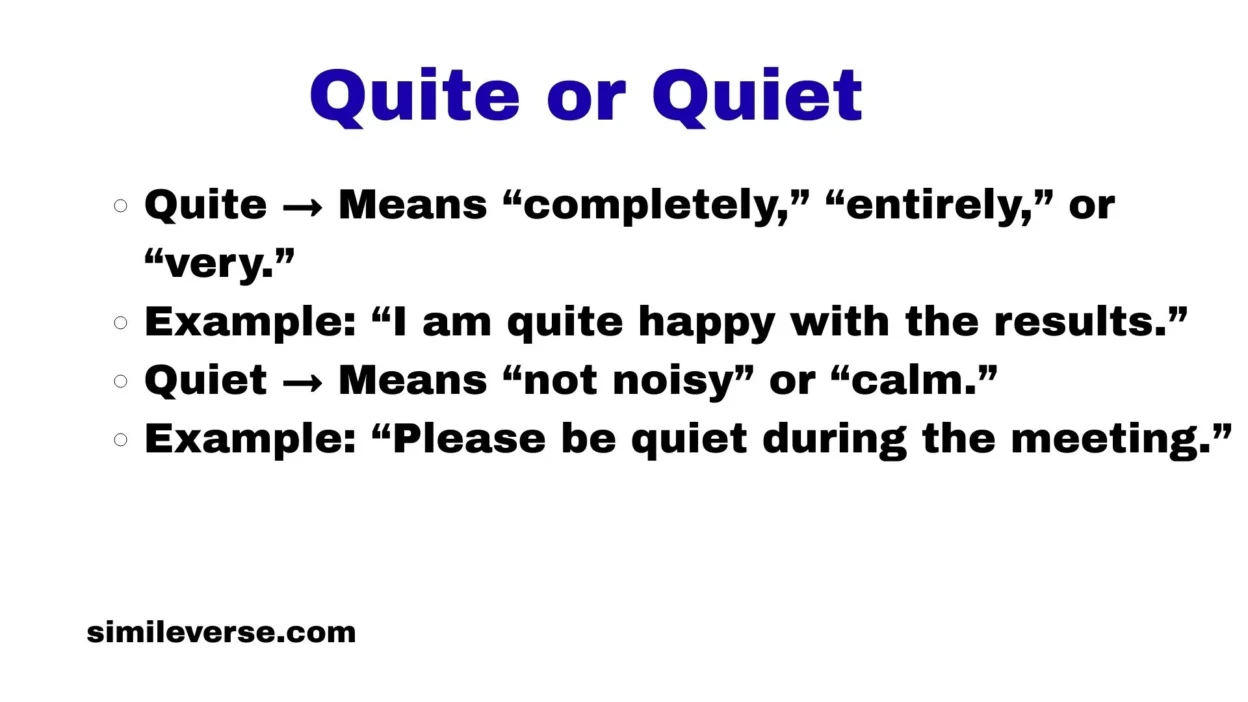
- Quite → Means “completely,” “entirely,” or “very.”
Example: “I am quite happy with the results.” - Quiet → Means “not noisy” or “calm.”
Example: “Please be quiet during the meeting.”
Quick tip: If you are talking about noise or calmness, use quiet. If you are expressing degree or emphasis, use quite.
The Origin of Quite or Quiet
- Quite comes from the Old French word quit, meaning “free” or “exactly.” Over time, it evolved to express completeness or emphasis in English.
- Quiet comes from the Latin word quietus, meaning “rest” or “peaceful.” It entered English around the 13th century to describe calmness or silence.
The historical difference explains why one word measures intensity (quite) and the other measures sound or calm (quiet).
British English vs American English Spelling
Both words are spelled the same in British and American English, so spelling isn’t the issue. The main confusion comes from pronunciation:
| Word | British Pronunciation | American Pronunciation | Meaning |
|---|---|---|---|
| Quite | /kwaɪt/ | /kwaɪt/ | Completely, very |
| Quiet | /ˈkwaɪ.ət/ | /ˈkwaɪ.ət/ | Calm, silent, not noisy |
Tip: Pronunciation differences are subtle. Context is the key to correct usage.
Which Spelling Should You Use?
Since both words are spelled the same in UK and US English, the focus should be on correct usage, not spelling:
- Use quiet when referring to noise, calmness, or peace.
- Use quite when referring to intensity, degree, or emphasis.
Global advice: Most English readers understand both words, but always double-check your sentence meaning.
Common Mistakes with Quite or Quiet
- ❌ “The room is quite.” → Correct: “The room is quiet.”
- ❌ “I am quiet happy.” → Correct: “I am quite happy.”
- ❌ “Be quite, please.” → Correct: “Be quiet, please.”
- ❌ Confusing the two in emails or formal writing → Always read aloud for clarity.
Rule of thumb: Replace with synonyms. If it makes sense as “very,” it’s quite. If it makes sense as “silent,” it’s quiet.
Quite or Quiet in Everyday Examples
- Email: “Please keep the office quiet while I call clients.”
- Social Media: “I am quite excited about the new movie release!”
- News: “The city remained quiet after the storm.”
- Formal Writing: “The results were quite significant for our research.”
Quite or Quiet – Google Trends & Usage Data
- Searches for “quite or quiet” peak during school terms and English exams.
- Most common in UK, US, Canada, and Australia.
- People often confuse the two in writing tests, essays, and professional emails.
Pro tip: Use Google Trends to see which word is searched more in your country and adjust your content accordingly.
Comparison Table
| Word | Meaning | Example | Usage Tip |
|---|---|---|---|
| Quite | Very, completely, entirely | “She is quite talented.” | Use for emphasis |
| Quiet | Silent, calm, not noisy | “Keep the library quiet.” | Use for sound or calmness |
FAQs
1. Can “quite” mean quiet?
No, “quite” expresses degree, not silence.
2. Can “quiet” express intensity?
No, “quiet” is always about calmness or silence.
3. Is “quite” formal or informal?
Both. It works in casual and formal English.
4. Is “quiet” used in idioms?
Yes, e.g., “quiet as a mouse.”
5. How do I remember the difference?
Think: Q-U-I-T-E = very; Q-U-I-E-T = silence.
6. Can I use both in the same sentence?
Yes, e.g., “The classroom was quiet, and I was quite impressed.”
7. Which word is searched more online?
“Quite or quiet” is a frequent query because of common confusion in English learners.
Conclusion
Understanding “quite” vs. “quiet” is simple if you focus on meaning, not just sound. Use quiet for silence and calmness, and quite for emphasis or intensity. Remember their origins: quietus brings calm, quite brings emphasis.
By practicing reading and listening carefully, and checking your sentences with synonyms, you can eliminate mistakes in emails, essays, and social posts. Always consider context—one word is about noise, the other about degree. With this guide, confusion over “quite or quiet” becomes a thing of the past.