Similes are fun and powerful tools in language that help us explain feelings clearly.
They compare one thing to another using words like “as” or “like.”
For kids and learners, similes make emotions easier to understand and imagine.
They also make writing more colorful, interesting, and expressive.
In this guide, we’ll explore powerful similes for “mad” in a simple, friendly way.
What Does “Mad” Mean in Simple Words?
Being mad means feeling angry, upset, annoyed, or furious. Everyone feels mad sometimes—kids, adults, teachers, and even characters in stories. Understanding different ways to describe anger helps us talk about our feelings better and write more creatively.
Example:
- “I was mad when my toy broke.”
Similes help turn that plain sentence into something vivid and memorable.
Why Use Similes to Describe Anger?
Similes help readers see and feel emotions instead of just reading about them.
Benefits for learners:
- Improves vocabulary
- Makes writing expressive
- Helps children explain feelings
- Makes stories more interesting
Example:
- Plain: He was mad.
- With simile: He was mad like a storm ready to burst.
How Similes Help Kids Understand Emotions
Children often struggle to explain feelings. Similes give them pictures in their minds.
Tip for kids:
If you can imagine it, you can explain it!
Example:
- Mad like a volcano helps kids imagine anger building up inside.
Difference Between Similes and Metaphors for Mad
- Simile: Uses like or as
- Mad like a raging bull
- Metaphor: Direct comparison
- He was a raging bull
For beginners and kids, similes are easier and safer to use.
Common Words Related to “Mad” (Semantic SEO Insight)
To write better, it helps to know similar words:
Angry, furious, annoyed, irritated, upset, enraged, cross, boiling, fuming.
Using these naturally improves writing and SEO.
Powerful Similes for Mad (Main List)
Below are 30+ powerful, kid-friendly, and creative similes for mad, explained clearly.
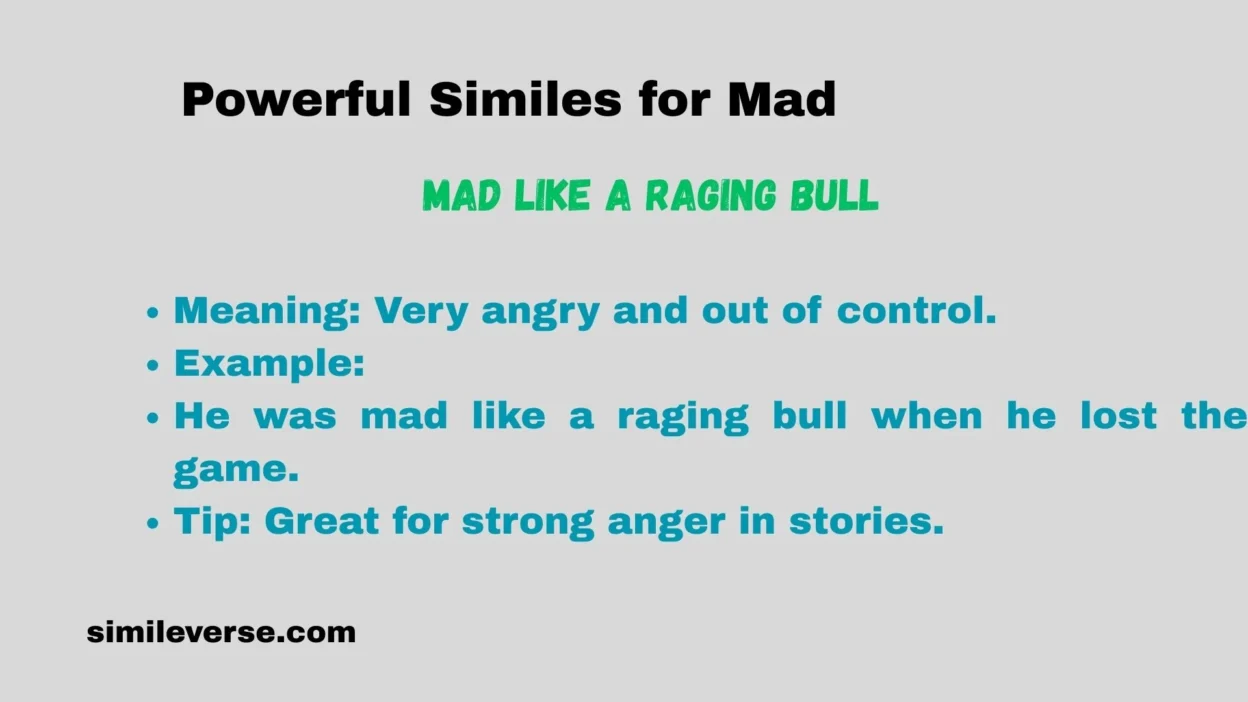
1. Mad Like a Raging Bull
Meaning: Very angry and out of control.
Example:
- He was mad like a raging bull when he lost the game.
<strong>Tip: Great for strong anger in stories.
2. Mad Like a Storm Ready to Burst
Meaning: Anger building up.
Example:
- She looked mad like a storm ready to burst.
Insight: Shows quiet anger turning loud.
3. Mad Like a Volcano About to Erupt
Meaning: Explosive anger.
Example:
- Dad was mad like a volcano after hearing the news.
Kid Tip: Volcano similes are easy to imagine.
4. Mad Like a Wasp Trapped in a Jar
Meaning: Angry and restless.
Example:
- He was mad like a wasp trapped in a jar.
Good for: Short stories and poems.
5. Mad Like Fire in Dry Grass
Meaning: Anger spreads quickly.
Example:
- Her anger spread like fire in dry grass.
Writing Tip: Shows sudden anger.
6. Mad Like a Lion Protecting Its Cubs
Meaning: Angry because of protection.
Example:
- She was mad like a lion protecting its cubs.
Insight: Shows justified anger.
7. Mad Like a Boiling Kettle
Meaning: Ready to explode with anger.
Example:
- He was mad like a boiling kettle.
Tip for kids: Easy everyday comparison.
8. Mad Like Thunder in the Sky
Meaning: Loud and frightening anger.
Example:
- His voice sounded mad like thunder.
9. Mad Like a Tornado
Meaning: Wild and destructive anger.
Example:
- She entered the room mad like a tornado.
Use Carefully: Best for fiction.
10. Mad Like a Hornet’s Nest
Meaning: Many angry feelings at once.
Example:
- The classroom felt mad like a hornet’s nest.
11. Mad Like a Barking Dog
Meaning: Loud and obvious anger.
Example:
- He was mad like a barking dog at strangers.
12. Mad Like a Crashing Wave
Meaning: Strong and unstoppable anger.
Example:
- His anger hit like a crashing wave.
13. Mad Like a Roaring Tiger
Meaning: Fierce anger.
Example:
- She was mad like a roaring tiger.
14. Mad Like a Thunderstorm at Night
Meaning: Scary and intense anger.
Example:
- The argument felt like a thunderstorm at night.
15. Mad Like a Snapping Crocodile
Meaning: Sudden and sharp anger.
Example:
- He replied mad like a snapping crocodile.
16. Mad Like a Burning Matchstick
Meaning: Short but intense anger.
Example:
- His temper was mad like a burning matchstick.
17. Mad Like a Screaming Siren
Meaning: Loud, alarming anger.
Example:
- Her shout was mad like a screaming siren.
18. Mad Like a Locked Pressure Cooker
Meaning: Anger building inside quietly.
Example:
- He stayed silent, mad like a pressure cooker.
19. Mad Like a Wild Horse
Meaning: Uncontrolled anger.
Example:
- She ran off mad like a wild horse.
20. Mad Like Ice Cracking in Winter
Meaning: Cold but dangerous anger.
Example:
- His calm voice hid anger like ice cracking.
21. Mad Like a Growling Bear
Meaning: Deep, warning anger.
Example:
- Dad sounded mad like a growling bear.
22. Mad Like a Spark in Darkness
Meaning: Sudden anger.
Example:
- His anger flashed like a spark in darkness.
23. Mad Like a Shaking Earthquake
Meaning: Powerful emotional anger.
Example:
- The news made her mad like an earthquake.
24. Mad Like a Breaking Glass
Meaning: Sharp and hurtful anger.
Example:
- His words were mad like breaking glass.
25. Mad Like a Buzzing Mosquito
Meaning: Annoyed and irritated.
Example:
- She felt mad like a buzzing mosquito.
26. Mad Like a Charging Rhino
Meaning: Aggressive anger.
Example:
- He rushed in mad like a charging rhino.
27. Mad Like a Burning Sun
Meaning: Intense and overwhelming anger.
Example:
- Her anger felt mad like the burning sun.
28. Mad Like a Flooded River
Meaning: Anger that overflows.
Example:
- His emotions were mad like a flooded river.
29. Mad Like a Cracked Drum
Meaning: Loud and chaotic anger.
Example:
- The argument sounded mad like a cracked drum.
30. Mad Like a Fire-Breathing Dragon
Meaning: Extreme anger (fantasy-friendly).
Example:
- The character was mad like a fire-breathing dragon.
Kids Love: Dragons make learning fun!
31. Mad Like a Shouting Crowd
Meaning: Collective anger.
Example:
- The room felt mad like a shouting crowd.
How to Choose the Right Simile for Mad
Ask yourself:
- Is the anger loud or quiet?
- Is it sudden or slow?
- Is it playful or serious?
Choosing the right simile makes writing clearer.
Tips for Kids to Use Similes Correctly
- Use like or as
- Don’t overuse similes
- Pick images you know
- Keep sentences simple
Similes for Mad in Story Writing
Similes make characters feel real.
Example:
- Tom was mad like a volcano, but he took a deep breath.
Similes for Mad in School Essays
Use gentle similes in essays.
Example:
- I felt mad like a boiling kettle during the test.
Common Mistakes to Avoid When Using Similes
- Mixing metaphors
- Using confusing comparisons
- Being too violent for kids
Why Teachers Love Teaching Similes
- Improves creative thinking
- Builds emotional intelligence
- Encourages expressive writing
How Parents Can Practice Similes with Kids
- Ask kids to describe feelings
- Turn emotions into pictures
- Use daily life examples
Final Thoughts: Why Similes for Mad Matter
Similes turn emotions into images.
They help kids express feelings safely and clearly.
They make writing powerful, creative, and memorable.
Learning powerful similes for mad builds confidence in language and communication.
Conclusion
Understanding and using similes for “mad” helps everyone—kids, students, teachers, parents, and writers—describe anger in a healthy, creative way. With over 30 powerful and easy similes, you now have the tools to make writing expressive, emotional, and engaging. Practice them, use them wisely, and let your words paint pictures.