Lionel Messi is widely regarded as one of the greatest footballers to ever play the game.
From his early days in Rosario, Argentina, to his legendary career at FC Barcelona and his recent move to Paris Saint-Germain, Messi’s journey is a testament to his unparalleled talent and work ethic.
Over the course of two decades, Messi has amassed a staggering array of records, goals, and titles that have solidified his legacy as a true footballing icon.
This article takes a deep dive into Messi’s career stats, breaking down his impressive achievements in both club and international football.
If it’s his remarkable goal tally, his numerous assists, or his record-breaking performances in La Liga and the Champions League, Messi’s stats reflect more than just numbers they tell the story of a player who has redefined the sport and inspired millions worldwide.
Let’s explore the incredible numbers that have defined Lionel Messi’s extraordinary career.
Early Life and Career Beginnings
Lionel Messi’s rise to football greatness didn’t happen overnight. Born in Rosario, Argentina, in 1987, Messi showed early promise as a football prodigy. His talent was undeniable, but at the age of 11, he was diagnosed with a growth hormone deficiency, which threatened his future in the sport. The treatment for the condition was expensive, and Messi’s family struggled to afford it. However, a lifeline came when Barcelona offered to cover the costs, inviting Messi to join their youth academy, La Masia, at just 13 years old.
Leaving his family behind and moving to Spain was a huge step, but it paid off. Messi quickly adapted to his new environment, outshining his peers with his exceptional dribbling skills, vision, and ability to score goals. By 2004, just three years after joining La Masia, Messi made his first-team debut for Barcelona at the age of 17.
Although he was still a teenager, his natural talent was apparent. Messi’s agility and sharp footballing intelligence quickly earned him a place in the starting lineup, and it wasn’t long before he began to break records. He became the youngest player ever to score for Barcelona in a competitive match and began to forge a reputation as one of the club’s brightest stars.
This early success marked the beginning of Messi’s extraordinary career, one that would soon see him rise to prominence as one of football’s all-time greats.
Breaking Down Messi’s Career Stats
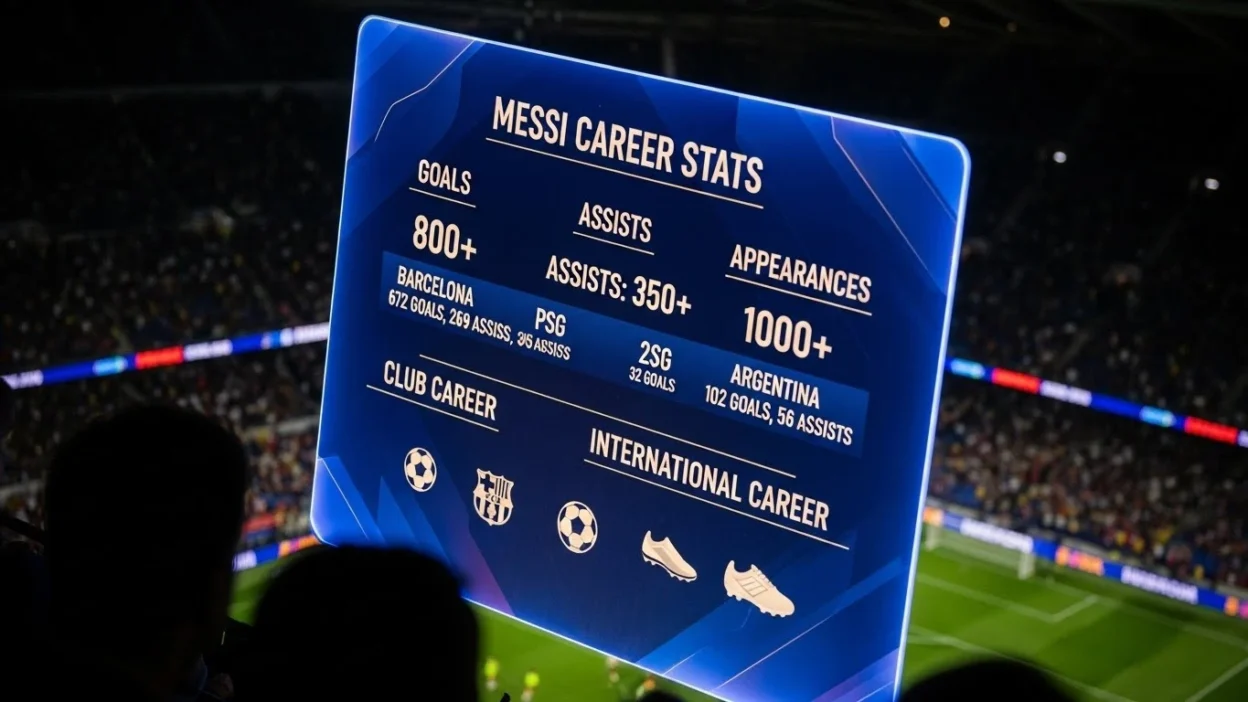
Lionel Messi’s career stats are a clear reflection of his extraordinary talent and consistency on the football pitch. As of 2025, Messi has scored over 800 career goals, making him one of the highest goal-scorers in football history. His ability to score goals in a variety of competitions—whether in domestic leagues, cups, or international tournaments—has solidified his status as one of the greatest finishers in the game.
At Barcelona, Messi spent 17 years dominating the football scene. During this period, he scored an incredible 672 goals in 778 appearances, making him Barcelona’s all-time top scorer. His goal-scoring feats include breaking the record for the most goals in a single La Liga season (50 goals in 2011-12) and the most goals in a calendar year (91 goals in 2012).
In addition to his goal-scoring prowess, Messi also registered over 300 assists throughout his career, demonstrating his incredible playmaking ability. His vision and precision in setting up goals for his teammates played a crucial role in Barcelona’s dominance, both in Spain and Europe.
Internationally, Messi has scored over 100 goals for Argentina, becoming the nation’s all-time top scorer. His achievements include a Copa América win in 2021 and an Olympic gold medal in 2008. Despite criticism in the past, Messi’s international record has now firmly placed him among the greats in the international football scene.
Messi’s career stats not only highlight his scoring ability but also his versatility, leadership, and contribution to the teams he’s played for.
Major Achievements and Records
Lionel Messi’s career is adorned with numerous individual awards and team honors, cementing his place as one of the greatest footballers of all time. His seven Ballon d’Or titles (as of 2025) are a testament to his dominance in the world of football, setting a record for the most Ballon d’Or wins in history. Messi’s consistency at the top level, combined with his unmatched talent, has made him the undisputed face of modern football.
At FC Barcelona, Messi’s honors include 10 La Liga titles, 7 Copa del Rey victories, and 4 UEFA Champions League trophies. He was instrumental in Barcelona’s dominance during the 2000s and 2010s, leading the team to countless memorable victories, including the iconic 2009 and 2015 Champions League triumphs. Messi’s ability to perform in high-pressure matches, scoring critical goals and assisting in crucial moments, contributed significantly to Barcelona’s success.
On the international stage, Messi’s career was often questioned due to Argentina’s failure to secure major international trophies. However, that changed in 2021, when Messi led Argentina to victory in the Copa América—his first major international title. This victory, coupled with an Olympic gold medal in 2008, helped silence critics and solidified Messi’s legacy as a true international champion.
In addition to his team achievements, Messi holds multiple records, including the most goals in La Liga history and the most goals in a single calendar year, with 91 goals in 2012. These milestones underscore his relentless pursuit of excellence.
Messi’s Role in Football Evolution
Lionel Messi’s influence on football extends far beyond his impressive career stats. He has redefined the way the game is played, evolving from a natural talent to an iconic figure who transformed modern football with his unique style. Known for his impeccable dribbling, close control, and vision, Messi revolutionized the role of the “false nine” at FC Barcelona under coach Pep Guardiola. Instead of being a traditional forward, Messi dropped deeper into midfield, orchestrating play and creating opportunities for his teammates while still maintaining his goal-scoring prowess.
Messi’s dribbling is often regarded as one of the best in history. His ability to glide past defenders with ease, often at high speeds, has become a hallmark of his playing style. Whether in tight spaces or during counter-attacks, Messi’s agility and balance allow him to operate in areas of the pitch where others might struggle. This technique, combined with his vision and passing, has allowed him to register countless assists, making him not just a goal scorer but also a playmaker.
Moreover, Messi’s consistency has been a key factor in his legacy. While many talented players peak for a few seasons, Messi’s sustained excellence over nearly two decades is what sets him apart. His performances have contributed to shifting the focus in football from purely athleticism to a combination of intelligence, creativity, and adaptability.
In essence, Messi has helped shape the modern game, influencing future generations of players, managers, and fans alike with his innovative style of play.
Messi’s Impact on Football Culture
Lionel Messi’s influence stretches far beyond the football pitch, making a lasting impact on the global football culture. As a figure, Messi represents not just talent, but humility, dedication, and an unwavering love for the game. Unlike many football superstars, Messi has maintained a relatively private and grounded lifestyle, which has made him a beloved figure among fans worldwide. His focus on the sport rather than personal fame has endeared him to millions who admire his work ethic and professionalism.
Messi’s influence extends to the youth development scene, where aspiring players look up to him as a model of excellence. His rise from a young boy battling a growth disorder to one of the greatest footballers ever has inspired countless youth players, especially in Argentina, where he remains a national hero. His story has shown that talent, paired with resilience and hard work, can overcome even the most challenging obstacles.
On a cultural level, Messi’s presence has elevated the global popularity of football, especially in countries where the sport’s status was already high, like Argentina, Spain, and Brazil. His rivalries—most notably with Cristiano Ronaldo—have sparked countless debates and fueled interest in the sport, even among casual fans. Additionally, Messi’s iconic moments, such as his dazzling performances in the El Clásico or his triumph in Copa América, have shaped the narrative of modern football, turning ordinary matches into cultural events.
Messi’s impact is felt not only in his statistics but in the way football is perceived worldwide.
Messi vs. Other Football Legends
The debate about who deserves to be crowned the greatest footballer of all time (GOAT) has long been dominated by Lionel Messi and his longstanding rival, Cristiano Ronaldo. However, the conversation about Messi’s place in football history goes beyond just his rivalry with Ronaldo. Players like Pelé, Diego Maradona, Johan Cruyff, and Zinedine Zidane also enter the conversation, and Messi’s career stands as a benchmark against which these footballing legends are measured.
While Cristiano Ronaldo has matched Messi in terms of raw goal-scoring numbers, Messi’s playing style is often considered more artistic and versatile. His ability to influence the game beyond scoring—through playmaking, dribbling, and vision—sets him apart. While Ronaldo is often praised for his athleticism, aerial ability, and powerful shot, Messi’s low center of gravity and dribbling in tight spaces allow him to navigate the most congested areas of the pitch, making his playmaking as integral as his goal-scoring.
When compared to Pelé and Maradona, Messi stands as the player with the most consistency over the longest period, having dominated for more than 17 years at the very top level. While Pelé’s World Cup victories and Maradona’s magical performances in the 1986 World Cup are legendary, Messi’s ability to perform in both domestic leagues and international tournaments, along with his record-breaking consistency, arguably places him on a higher pedestal.
Ultimately, the Messi vs. football legends debate is subjective, but Messi’s career achievements ensure he’ll forever be at the forefront of this conversation.
Legacy and Future of Messi’s Career
As Lionel Messi moves further into the twilight years of his career, his legacy is already firmly cemented as one of the greatest footballers in history. Beyond the numerous titles, records, and goals, Messi’s impact on the sport will be felt for generations to come. His ability to redefine footballing excellence and inspire millions worldwide has solidified his place as a global icon.
Messi’s legacy goes beyond the statistics; it’s about the way he played the game. His humble demeanor, love for the sport, and dedication to improving year after year are traits that have set him apart from many other superstars. His approach to the game, marked by creativity and playmaking, has influenced how young players develop and approach football, emphasizing vision, intelligence, and technique over sheer physicality.
Looking to the future, Messi’s impact will continue to shape football culture. Whether it’s through his involvement in football academies, charity work, or simply mentoring the next generation of talent, Messi’s influence is far from over. Even as he ages, his role in global football—whether through leadership at PSG, his continuing role with the Argentine national team, or potential ventures into management or business—ensures that his legacy will continue to grow.
Messi’s future remains a subject of intrigue. However, no matter what he chooses to do next, one thing is certain: his name will forever be synonymous with football greatness.
Frequently Asked Questions (FAQ)
1. How many goals has Lionel Messi scored in his career?
As of 2025, Messi has scored over 800 career goals across various competitions, including club football and international matches with Argentina. This incredible feat places him among the top goal-scorers in football history.
2. How many Ballon d’Or awards has Messi won?
Lionel Messi has won 7 Ballon d’Or awards, a record for the most ever received by a single player. He has dominated the award, winning it in multiple years throughout his career, cementing his status as one of the greatest players of all time.
3. What major trophies has Messi won with Barcelona?
During his illustrious career at Barcelona, Messi won numerous titles, including 10 La Liga titles, 7 Copa del Reys, and 4 UEFA Champions League trophies. These accomplishments were key to Barcelona’s dominance in Spain and Europe.
4. Has Messi won the World Cup?
Messi has not won the FIFA World Cup, but he came close in 2014, finishing as runner-up with Argentina. However, he achieved significant international success by winning the Copa América in 2021 and the Olympic gold medal in 2008.
5. What is Messi’s role in football history?
Messi is often considered one of the greatest footballers of all time. His unique playing style, consistency, and numerous records have redefined the sport and inspired generations of players and fans worldwide.
Conclusion
Lionel Messi’s career is a story of unparalleled greatness. From a young boy in Rosario with a growth hormone deficiency to a global footballing icon, Messi’s journey is one of perseverance, talent, and passion.
His stats—over 800 goals, 7 Ballon d’Ors, and countless team trophies—tell a remarkable tale, but they only scratch the surface of what he has achieved. Messi has not only set records but has also defined the very essence of modern football with his unique style of play.
Through his long-standing dominance in La Liga with Barcelona, his impactful moments with the Argentina national team, and his success at PSG, Messi has shown what it means to be not just a footballer but a true ambassador of the sport. His influence extends far beyond the field, inspiring millions of fans and future generations of players.
While the debate over his place in history will continue, Messi’s legacy is undeniable.
His combination of vision, creativity, and consistency has made him a player that future generations will look to as the gold standard in football. Even as Messi’s playing days draw to a close, his impact on football will endure for years to come, whether through his records, his influence on the next wave of talent, or his role as a global ambassador for the beautiful game.