Have you ever paused mid-sentence and wondered, “Is it lieing or lying?” You’re not alone. This is one of the most searched spelling questions in English, and for good reason. The confusion happens because English spelling rules often change when we add -ing to verbs. Sometimes letters are dropped, sometimes they stay, and sometimes… well, it just feels unfair.
People search for lieing or lying because both spellings look possible. After all, we have words like tie → tying and die → dying. So why doesn’t lie become lieing? That’s where the confusion starts.
This article clears it all up in a simple, no-stress way. You’ll get a quick answer, learn why the spelling changes, see real-life examples, and understand which spelling you should use depending on your audience. By the end, you’ll never second-guess this word again—and you’ll avoid a common spelling mistake that can hurt writing quality, SEO, and professional credibility.
Lieing or Lying – Quick Answer
The correct spelling is lying.
❌ Lieing is always wrong.
Why?
When a verb ends in -ie, the -ie changes to -y before adding -ing.
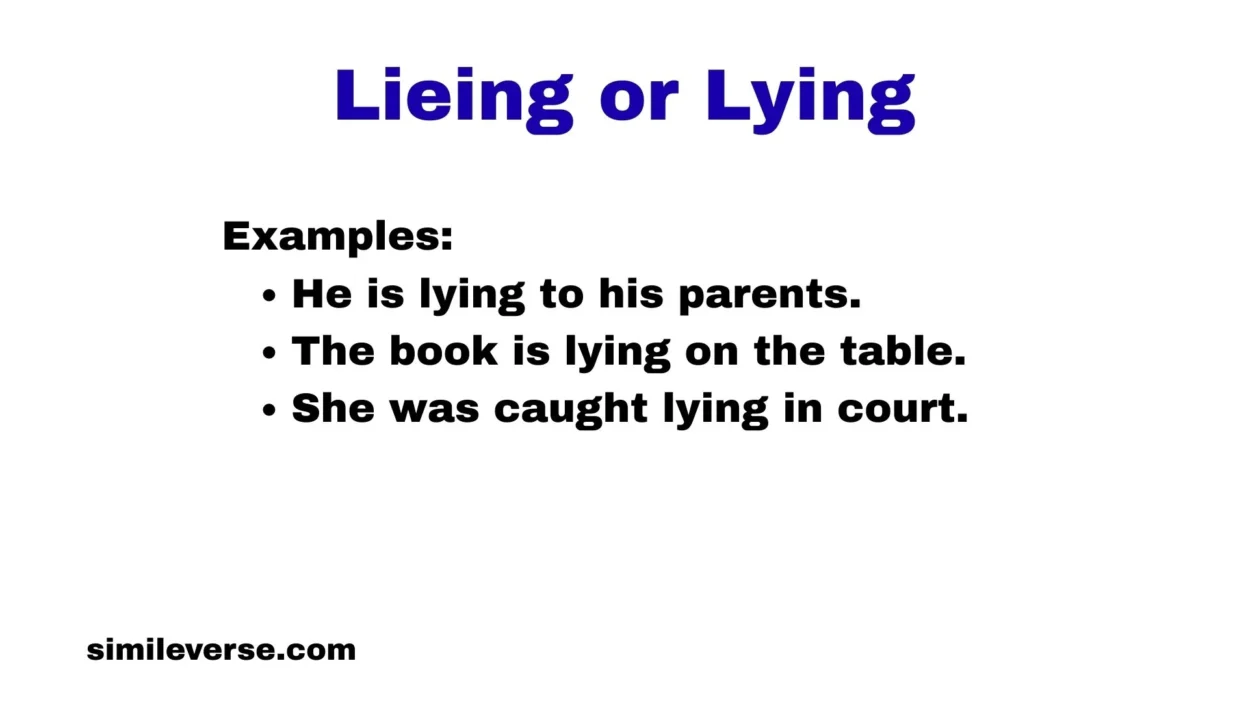
Examples:
- He is lying to his parents.
- The book is lying on the table.
- She was caught lying in court.
🚫 Incorrect:
- He is lieing to his parents.
The Origin of Lieing or Lying
The verb lie comes from Old English licgan, meaning “to rest” or “to recline.” Over time, English developed spelling rules to make words easier to pronounce and read.
One key rule is this:
Verbs ending in -ie drop the -ie and add -ying.
This rule exists to avoid awkward spellings like lieing, which would be harder to read and pronounce. Instead, English simplifies it to lying, which flows more naturally.
This same rule applies to:
- die → dying
- tie → tying
So, lying follows a long-standing English spelling pattern—not an exception.
British English vs American English Spelling
Good news: there is no difference here.
Both British English and American English use lying.
Lieing is incorrect in all major English varieties.
Comparison Table
| Form | British English | American English | Correct? |
|---|---|---|---|
| lying | ✔ Yes | ✔ Yes | ✅ Correct |
| lieing | ❌ No | ❌ No | ❌ Incorrect |
Unlike words such as colour/color or travelling/traveling, this spelling never changes by region.
Which Spelling Should You Use?
Always use lying, no matter who you’re writing for.
Audience-based advice:
- US audience: Use lying
- UK audience: Use lying
- Australia, Canada, India: Use lying
- Global or SEO content: Use lying
There is no situation where lieing is acceptable in modern English.
Common Mistakes with Lieing or Lying
Here are the most frequent errors people make:
❌ Mistake 1: Adding “-ing” directly
- He is lieing again.
✔ Correct: He is lying again.
❌ Mistake 2: Confusing lie (rest) and lie (falsehood)
Both meanings still use lying:
- He is lying on the bed.
- He is lying to his boss.
❌ Mistake 3: Assuming regional spelling differences
- There is no British or American variation here.
Lieing or Lying in Everyday Examples
Emails
- ❌ I think he is lieing about the report.
- ✔ I think he is lying about the report.
News
- The witness was lying under oath.
Social Media
- Stop lying to your followers.
Formal Writing
- The data suggests the defendant was lying during testimony.
Lieing or Lying – Google Trends & Usage Data
Search data shows that “lieing or lying” is a high-intent keyword. Users are actively looking for a clear, fast answer.
Usage insights:
- “Lying” is used millions of times across books, media, and online content.
- “Lieing” spikes mainly in:
- Spell-check queries
- Student searches
- ESL learning contexts
This tells us one thing: people aren’t using lieing—they’re checking if it’s wrong.
Comparison Table: Keyword Variations
| Keyword Variation | Correct | Usage |
|---|---|---|
| lying | ✅ Yes | Standard English |
| lieing | ❌ No | Common misspelling |
| is lying | ✅ Yes | Correct verb phrase |
| was lying | ✅ Yes | Correct past form |
FAQs About Lieing or Lying
1. Is “lieing” ever correct?
No. Lieing is never correct in English.
2. Why does lie become lying?
Because verbs ending in -ie change to -y before adding -ing.
3. Does this rule apply to all verbs?
Only verbs ending in -ie, like die and tie.
4. Is lying the same for truth and position?
Yes. Both meanings use lying.
5. Do British and American English differ here?
No. Both use lying.
6. Can spell-check catch this mistake?
Most modern tools flag lieing as incorrect.
7. Is this a common ESL mistake?
Yes, especially for new English learners.
Conclusion
The confusion between lieing or lying is common—but the rule is simple once you know it. Lying is the only correct spelling. The word lieing does not exist in standard English and should never be used in formal, professional, or casual writing.
Remember the rule:
👉 If a verb ends in -ie, change it to -y before adding -ing.
This applies everywhere—emails, essays, social media posts, news articles, and SEO content. There are no regional differences and no exceptions to worry about. Using the correct spelling improves clarity, credibility, and confidence in your writing.
If you remember just one thing, let it be this:
People lie, but spelling shouldn’t. Always write lying.