Have you ever seen words written in a slightly slanted style and wondered what they represent? That styling is known as italics. Many people search for italics meaning because they notice it in books, social media posts, school assignments, captions, or even professional documents. Sometimes it signals emphasis. Other times it highlights titles, foreign words, or inner thoughts.
Understanding what italics communicate can improve your writing, reading comprehension, and even online communication skills. Whether you’re a student formatting an essay, a content creator writing captions, or someone trying to interpret tone in a message, knowing how italics function helps you avoid confusion.
In this guide, we’ll explore the definition, history, and practical usage of italics across different fields—from casual chats to professional terminology—while clearing up common misunderstandings.
Meaning & Definition
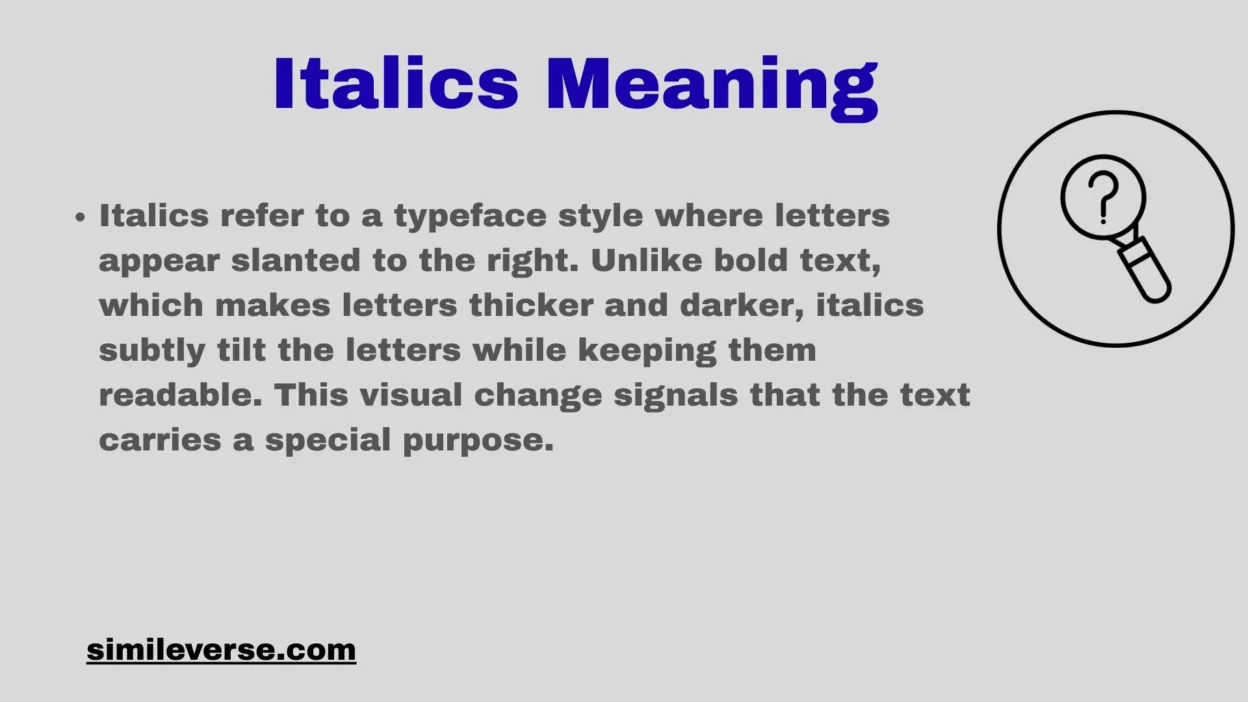
Italics refer to a typeface style where letters appear slanted to the right. Unlike bold text, which makes letters thicker and darker, italics subtly tilt the letters while keeping them readable. This visual change signals that the text carries a special purpose.
In simple terms, italics are used to:
- Emphasize certain words
- Indicate titles of books, movies, or artworks
- Show foreign or unfamiliar words
- Represent internal thoughts in storytelling
For example:
- I really didn’t mean that. (emphasis)
- I just finished reading Pride and Prejudice. (book title)
- The word déjà vu comes from French. (foreign phrase)
The meaning behind italics depends on context. In formal writing, they follow strict grammar rules. In informal communication, they often express tone or emotional emphasis. Because tone can be hard to convey in text, italics help add subtle emotional cues without sounding dramatic.
Background
The italic type style dates back to the Renaissance period in Italy during the 15th century. It was developed as a more compact and elegant script inspired by handwritten calligraphy. The term itself comes from “Italian style.”
Early printers used italic fonts to save space and imitate sophisticated handwriting. Over time, italics became standardized in typography and publishing. As printing evolved, style guides began defining specific rules for when to use italics—especially for titles of major works like books, films, and academic journals.
With the rise of digital communication, italics became even more versatile. Word processors, blogs, and social media platforms introduced formatting tools that made it easy to italicize text with a simple click. Today, italics are part of everyday communication across both formal and informal platforms.
Interestingly, even when formatting tools aren’t available, people mimic italics by using symbols like underscores (word) or asterisks (word), especially in chat apps.
Usage in Different Contexts
Italics serve different purposes depending on where they are used.
Academic Writing
In essays and research papers, italics are commonly used for:
- Book and journal titles
- Scientific names of species
- Foreign words not commonly used in English
Example:
- Homo sapiens is the scientific name for humans.
Creative Writing
Authors use italics to:
- Show internal thoughts
- Emphasize emotional dialogue
- Distinguish flashbacks or dream sequences
Example:
- What if I fail? she wondered.
Professional Fields
In business or corporate writing, italics are used sparingly. Overusing them can make documents appear unprofessional. Instead, they’re applied for subtle emphasis or publication titles.
Media & Publishing
Newspapers, magazines, and online blogs use italics primarily for titles of major works such as:
- Books
- Movies
- TV shows
- Newspapers
For example:
- The movie Inception became a global hit.
In short, the meaning behind italicized words depends heavily on the environment in which they appear.
Meaning in Chat, WhatsApp, Instagram, TikTok
On messaging platforms, italics usually indicate emphasis or tone. Since body language and vocal tone are missing in text conversations, formatting fills that gap.
On WhatsApp, typing text between underscores (like this) automatically converts it into italics. On Instagram captions or TikTok comments, people may use stylized fonts or formatting apps to create italic text.
In chats, italics can imply:
- Emotional emphasis
- Sarcasm
- Clarification
- Dramatic effect
Example:
- I told you already. (suggests frustration)
- Oh, that’s great. (could suggest sarcasm)
Because tone is subjective, italicized words may sometimes be misunderstood. That’s why context matters.
On dating apps, italics may highlight flirtation or playful teasing:
- So you’re that kind of traveler?
In casual digital settings, italics are more about tone and personality than strict grammar rules.
Meaning in Physics, Medical, and Aircraft Terminology
In technical fields, italics have specific formatting rules.
Physics & Mathematics
In scientific writing, variables are often written in italics to distinguish them from regular text.
Example:
- The formula E = mc² uses italicized variables.
This helps readers clearly identify symbols representing measurable quantities.
Medical Terminology
In medicine and biology:
- Scientific names of organisms are italicized.
- Latin terms may appear in italics.
Example:
- Escherichia coli is a common bacterium.
Aircraft & Engineering
In aviation manuals or technical documents, italics may:
- Emphasize warnings
- Indicate variable placeholders
- Highlight system names
For instance:
- Set altitude to X feet.
Here, the italic letter represents a changing value rather than a fixed term.
In these contexts, italics are less about emotion and more about clarity and standard formatting.
Common Misconceptions
Many people misunderstand how italics should be used.
Misconception 1: Italics and bold mean the same thing.
They don’t. Bold text draws strong attention, while italics provide subtle emphasis.
Misconception 2: Every emphasized word should be italicized.
Overuse reduces impact and may look unprofessional.
Misconception 3: Short titles should always be italicized.
Actually, short works like poems or articles are usually placed in quotation marks instead.
Misconception 4: Italics are only for formal writing.
They’re widely used in informal chats and digital spaces too.
Understanding these differences prevents formatting errors.
Similar Terms & Alternatives
Italics are often confused with:
- Bold – thicker, darker text for strong emphasis
- Underline – line beneath text for emphasis or links
- Quotation marks – used for short titles or direct speech
- Capitalization – sometimes used for emphasis in casual chat
Each formatting style serves a different purpose. For example:
- Subtle emphasis (italics)
- Strong emphasis (bold)
- “Short title” (quotation marks)
Choosing the correct format improves clarity and professionalism.
How to Respond to Italicized Text
When someone uses italics in conversation, pay attention to tone.
If italics show emphasis:
- Respond thoughtfully and acknowledge the emphasis.
Example:
- I really needed your help.
Response: I understand. I’m sorry I wasn’t available.
If italics suggest sarcasm:
- Clarify intent before reacting emotionally.
Example:
- Oh, that’s perfect.
Response: Do you mean that seriously, or is something wrong?
In professional settings, respond normally unless the italics indicate technical meaning or variable references.
Understanding why a word is italicized helps you interpret intent accurately.
Differences from Similar Words
Italics differ from bold and underline in visual impact and usage.
- Italics → subtle emphasis or formatting standard
- Bold → strong attention or headings
- Underline → links or strong emphasis
In digital design, italics are considered softer and more refined. Bold commands attention. Underline often signals clickable links online.
Knowing these differences ensures correct formatting in academic, professional, and casual settings.
Relevance in Online Conversations & Dating Apps
In modern digital communication, italics play a key role in expressing tone. Since text lacks facial expressions and voice inflection, formatting adds emotional nuance.
On dating apps, italics can:
- Highlight playful teasing
- Add flirtatious emphasis
- Clarify intent
Example:
- So you’re always this adventurous?
In online debates, italics may stress key arguments:
- That’s exactly my point.
However, excessive use may seem dramatic or passive-aggressive. Balance is essential.
Understanding this subtle formatting tool helps you communicate more clearly and interpret messages more accurately.
Conclusion
Italics are more than just slanted text—they are a powerful formatting tool that adds meaning, tone, and clarity to written communication. From academic papers and scientific formulas to WhatsApp chats and dating apps, italics serve multiple purposes depending on context.
They can emphasize emotion, indicate titles, distinguish technical variables, or highlight foreign terms. However, misuse or overuse can reduce clarity and impact. Understanding when and why italics are applied ensures more effective communication.
Whether you’re writing a school essay, posting on social media, or decoding tone in a message, knowing the true meaning behind italicized text allows you to read between the lines—literally and figuratively.
Mastering this small but significant formatting style can instantly improve your writing confidence and digital communication skills.