Have you ever paused while writing and wondered: is it “gases” or “gasses”? You are not alone. This is one of the most searched spelling questions in English, especially among students, writers, bloggers, and professionals. The confusion happens because both spellings look correct, sound the same, and even appear in real writing.
People search for “gases or gasses” to get a quick answer, avoid grammar mistakes, and sound professional in emails, schoolwork, science writing, or online posts. The problem becomes bigger because English verbs often double letters, while plural nouns usually do not. This mix-up makes even confident writers second-guess themselves.
This guide solves that confusion once and for all. You will learn which spelling is correct, why it exists, how British and American English treat it, and when the other spelling is used. By the end, you will know exactly what to write—without doubt or hesitation.
Gases or Gasses – Quick Answer
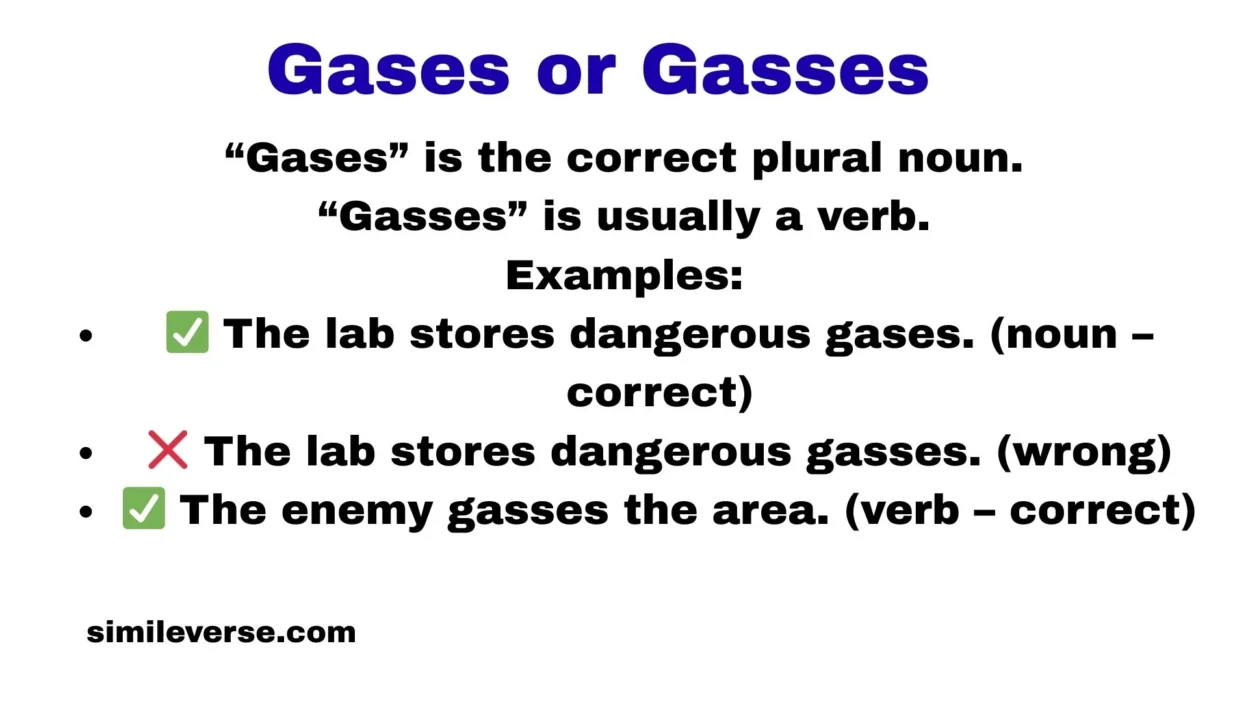
“Gases” is the correct plural noun.
“Gasses” is usually a verb.
Examples:
- ✅ The lab stores dangerous gases. (noun – correct)
- ❌ The lab stores dangerous gasses. (wrong)
- ✅ The enemy gasses the area. (verb – correct)
Quick rule:
- Plural noun → gases
- Verb (action) → gasses
The Origin of Gases or Gasses
The word “gas” comes from the 17th century. It was created by a scientist named Jan Baptist van Helmont. He used it to describe air-like substances that were not solid or liquid.
When English forms plurals, it usually adds -es after words ending in -s. That is why:
- gas → gases
The spelling “gasses” appeared later as a verb form. English often doubles consonants when adding endings to short verbs.
- gas → gasses → gassed
So, the difference exists because one spelling follows noun rules, and the other follows verb spelling rules.
British English vs American English Spelling
Both British English and American English follow the same rule for this word. There is no regional spelling difference.
Comparison Table
| Usage Type | Correct Spelling | Example |
|---|---|---|
| Plural noun | gases | Toxic gases leaked |
| Present tense verb | gasses | He gasses the room |
| Past tense verb | gassed | The area was gassed |
✔ Same in the US
✔ Same in the UK
✔ Same worldwide
Which Spelling Should You Use?
Your choice depends on how you are using the word, not where you live.
Use gases if:
- You are talking about science
- You mean more than one gas
- You are writing formally or academically
Example:
Greenhouse gases affect climate.
Use gasses if:
- You are describing an action
- Someone is releasing gas
Example:
The machine gasses the chamber.
Simple tip:
If you can replace the word with “releases gas,” use gasses.
Otherwise, use gases.
Common Mistakes with Gases or Gasses
Here are frequent errors people make:
❌ Mistake 1:
Poison gasses filled the room.
✔ Correction:
Poison gases filled the room.
❌ Mistake 2:
The factory gases workers every day.
✔ Correction:
The factory gasses workers every day. (this one is correct because it is a verb)
❌ Mistake 3:
Using both spellings as plurals
✔ Rule to remember:
- Only gases is a plural noun.
Gases or Gasses in Everyday Examples
Emails
- Please check the storage of industrial gases.
- The system gasses the container before sealing.
News
- Harmful gases were released after the explosion.
Social Media
- Cars release dangerous gases every day.
Formal Writing
- Noble gases are chemically stable elements.
Gases or Gasses – Google Trends & Usage Data
Search data shows that “gases” is far more popular worldwide. It appears most often in:
- Science content
- Education
- Environmental news
“Gasses” appears less often and mainly in:
- Historical writing
- Military contexts
- Verb-based sentences
By country:
- USA: gases (science, climate topics)
- UK: gases (education, news)
- Global: gases dominates searches
This proves that most people are looking for the plural noun, not the verb.
Comparison Table: Gases vs Gasses
| Word | Part of Speech | Meaning | Example |
|---|---|---|---|
| gases | Noun (plural) | More than one gas | Oxygen and nitrogen are gases |
| gasses | Verb | Releases gas | The device gasses the room |
FAQs: Gases or Gasses
1. Is “gasses” ever correct?
Yes. It is correct only as a verb, not as a plural noun.
2. What is the plural of gas?
The plural of gas is gases.
3. Do British and American English spell it differently?
No. Both use gases as the plural noun.
4. Can I use “gasses” in science writing?
Only if you mean an action. For substances, always use gases.
5. Why does English allow both spellings?
Because English has different rules for nouns and verbs.
6. Which spelling is safer for general writing?
Gases is safer and more commonly used.
7. Is “gasses” considered a mistake?
It is a mistake only when used as a plural noun.
Conclusion
The confusion between gases or gasses is common, but the rule is simple once you know it. “Gases” is always the correct plural noun, used in science, education, news, and daily writing. “Gasses” is a verb, used only when someone or something releases gas.
There is no British or American difference here, which makes the rule even easier to follow. If you remember just one thing, remember this: things are gases; actions gasses. This single idea can save you from spelling errors in emails, exams, articles, and professional work.
Using the correct form improves clarity and builds trust with readers. Now that you know the difference, you can write with confidence and accuracy every time.