Have you ever paused while writing an email, poster, or blog and wondered: is it flyer or flier? You’re not alone. This is one of those English spelling questions that trips up students, writers, marketers, and even native speakers. Both spellings look right. Both are used. And confusingly, both are correct—just in different situations.
People search for “flyer or flier” because they want a fast, clear answer. Are these two words interchangeable? Does American English prefer one while British English prefers the other? And what about flyers for events versus someone who flies an airplane?
This article clears all that confusion. You’ll learn the quick rule, the history behind both spellings, and how usage changes across countries and contexts. We’ll also show real-life examples from emails, news, and social media, plus common mistakes to avoid. By the end, you’ll know exactly which spelling to use—and when—without second-guessing yourself.
Flyer or Flier – Quick Answer
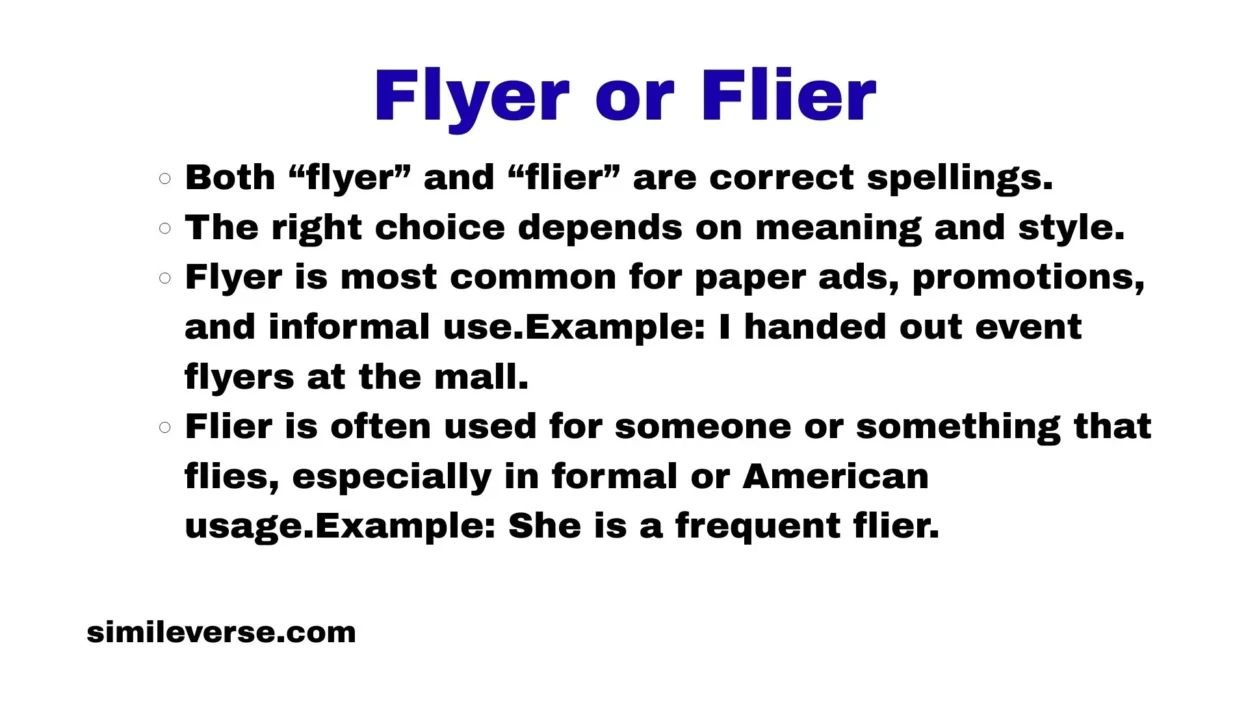
Both “flyer” and “flier” are correct spellings.
The right choice depends on meaning and style.
- Flyer is most common for paper ads, promotions, and informal use.
- Example: I handed out event flyers at the mall.
- Flier is often used for someone or something that flies, especially in formal or American usage.
- Example: She is a frequent flier.
Quick tip:
👉 If you mean a paper advertisement, use flyer.
👉 If you mean a person or thing that flies, flier is often preferred.
The Origin of Flyer or Flier
Both words come from the verb “to fly,” which dates back to Old English flēogan, meaning to move through the air.
- Flier follows a traditional spelling rule in English.
When a word ends in -y (fly), the y often changes to i before adding -er.- Fly → flier
- Flyer developed later as a simplified and more visual spelling, especially in printing and advertising.
Over time, flyer became popular for handbills and promotions because it looked clearer and was easier to read quickly. Flier stayed closer to grammar rules and formal writing.
That’s why both spellings survived—and are still used today.
British English vs American English Spelling
Both British and American English use flyer and flier, but preferences differ by context.
General Differences
- American English
- Uses flier for aviation and people.
- Uses flyer for advertisements and informal use.
- British English
- Strongly prefers flyer in most cases.
- Rarely uses flier.
Comparison Table
| Context | American English | British English |
|---|---|---|
| Paper advertisement | Flyer | Flyer |
| Person who flies | Flier | Flyer |
| Marketing content | Flyer | Flyer |
| Formal writing | Flier (sometimes) | Flyer |
Which Spelling Should You Use?
The best spelling depends on your audience.
If your audience is in the United States:
- Use flyer for ads, posters, promotions.
- Use flier for aviation, travel, or people who fly often.
If your audience is in the UK or Commonwealth countries:
- Use flyer for almost everything.
If your audience is global or online:
- Flyer is the safest choice.
It’s more familiar, more common, and widely accepted worldwide.
Common Mistakes with Flyer or Flier
Here are frequent errors people make:
❌ Using flier for printed ads
✔️ Correct: I designed a flyer for the event.
❌ Thinking one spelling is “wrong”
✔️ Truth: Both are correct.
❌ Mixing spellings in the same document
✔️ Tip: Pick one style and stay consistent.
❌ Overthinking casual writing
✔️ In everyday use, flyer works fine.
Flyer or Flier in Everyday Examples
Emails
- Please find the event flyer attached.
- He is a frequent flier with the airline.
News
- The city distributed flyers about road closures.
- Discounts are offered to frequent fliers.
Social Media
- New concert flyer just dropped!
- I’m a nervous flier but excited to travel.
Formal Writing
- The program rewards loyal fliers.
- Marketing materials included printed flyers.
Flyer or Flier – Google Trends & Usage Data
Search data shows that “flyer” is far more popular worldwide.
- Flyer dominates searches in:
- UK
- Canada
- Australia
- Marketing and business contexts
- Flier appears more often in:
- US aviation terms
- Travel programs like “frequent flier”
Overall, flyer is searched and used more often, especially online and in content creation.
Flyer vs Flier Comparison Table
| Word | Meaning | Common Use | Preferred Regions |
|---|---|---|---|
| Flyer | Paper ad or promotion | Marketing, events | Global |
| Flier | Person or thing that flies | Aviation, travel | Mostly US |
FAQs About Flyer or Flier
1. Is flyer or flier correct?
Both are correct English spellings.
2. Which spelling is more common?
Flyer is more common worldwide.
3. Should I use flyer or flier for advertising?
Use flyer.
4. What about “frequent flyer”?
In US English, frequent flier is also correct and widely used.
5. Is flier outdated?
No, but it is less common outside formal or aviation contexts.
6. Do dictionaries accept both spellings?
Yes, major dictionaries list both.
7. Which is better for SEO content?
Flyer is usually better due to higher search volume.
Conclusion
The debate between flyer or flier isn’t about right versus wrong—it’s about context and audience. Both spellings are correct, accepted, and widely used. The key is knowing when to use each one.
If you’re talking about advertising, events, or promotions, flyer is the clear winner. It’s simple, familiar, and works well for global audiences. If you’re writing about aviation or people who fly, especially in American English, flier may be the better fit.
For most writers, students, and content creators, flyer is the safest and most versatile choice. It avoids confusion, aligns with global usage, and matches modern writing trends. Choose one spelling, stay consistent, and write with confidence.