Many people search for “flip or flop” because they’ve seen it used in news headlines, business talks, sports comments, or even TV shows—and they’re not always sure what it really means. Is it about success or failure? Is it a verb or a noun? Or is it just a casual phrase?
The confusion happens because “flip” and “flop” can work together as an idiom, separately as verbs, or as descriptive words in different contexts. Sometimes “flip” suggests success or change, while “flop” often means failure. Put together, “flip or flop” usually describes an uncertain outcome—something that could succeed or fail.
People also wonder if this phrase changes in British or American English, if it needs hyphens, or how formal it is. This article clears all that up. You’ll get a quick answer, simple examples, spelling guidance, common mistakes, real-life usage, trend insights, and expert advice—all written in clear, easy language. By the end, you’ll know exactly how and when to use “flip or flop” with confidence.
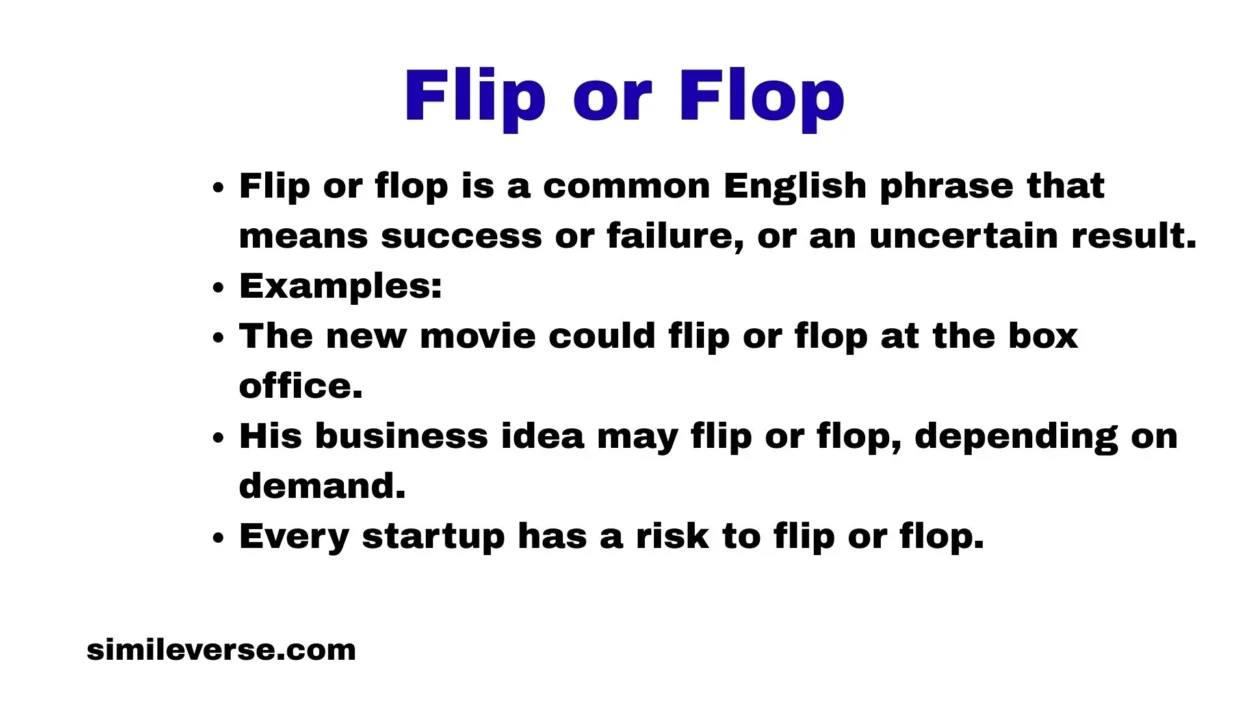
Flip or Flop
Flip or flop is a common English phrase that means success or failure, or an uncertain result.
Examples:
- The new movie could flip or flop at the box office.
- His business idea may flip or flop, depending on demand.
- Every startup has a risk to flip or flop.
👉 In simple terms: flip = succeed, flop = fail.
The Origin of Flip or Flop
The words flip and flop both come from old English sound-based words.
- Flip originally meant a quick movement or turn.
- Flop described a heavy fall or failure-like sound.
Over time, people began using flip to suggest success or change and flop to describe failure. By the 19th century, writers started pairing them to show opposite outcomes.
That’s why “flip or flop” became a popular phrase—it clearly shows two possible results. There are no spelling variations for this phrase because it’s an idiom, not a compound word.
British English vs American English Spelling
Good news: there is no spelling difference between British and American English for “flip or flop.”
Both regions use:
- flip or flop
- no hyphens
- no spelling changes
Comparison Table
| English Variant | Correct Form | Notes |
|---|---|---|
| American English | flip or flop | Used in business, sports, media |
| British English | flip or flop | Same meaning and spelling |
| Australian English | flip or flop | Informal but common |
| Global English | flip or flop | Widely understood |
Which Spelling Should You Use?
Always use “flip or flop” exactly as written.
Audience-based advice:
- US audience: Use freely in business and media writing
- UK/Commonwealth: Safe in both speech and writing
- Global readers: Clear, simple, and widely understood
💡 Tip: Avoid overusing it in very formal legal or academic writing.
Common Mistakes with Flip or Flop
Here are mistakes people often make:
flip and flop (changes the meaning)
✅ flip or flop
❌ flip-flop (this is a different phrase meaning “change opinion”)
✅ flip or flop
flop or flip (rare and unnatural order)
✅ flip or flop
Flip or Flop in Everyday Examples
Emails:
- This campaign may flip or flop, but we should try.
News:
- Analysts say the policy could flip or flop this year.
Social Media:
- New phone launch—will it flip or flop? 📱
Formal Writing:
- The project’s success remains a flip or flop scenario.
Flip or Flop – Google Trends & Usage Data
Search interest for “flip or flop” is highest in:
- United States
- United Kingdom
- Canada
- Australia
It’s often searched alongside:
- business ideas
- movies
- startups
- TV shows
People usually want to know:
- the meaning
- how to use it correctly
- if it’s formal or casual
Comparison Table: Keyword Variations
| Phrase | Meaning | Correct Usage |
|---|---|---|
| flip or flop | succeed or fail | ✅ Correct |
| flip-flop | change opinion | ❌ Different meaning |
| flop | fail badly | ✅ Correct |
| flip | quick change or success | ✅ Correct |
FAQs About Flip or Flop
1. What does flip or flop mean?
It means something may succeed or fail.
2. Is flip or flop formal?
It’s semi-formal and fine for most writing.
3. Is flip-flop the same as flip or flop?
No. Flip-flop means changing opinions.
4. Does flip or flop need a hyphen?
No hyphen is used.
5. Is flip or flop American slang?
No. It’s used worldwide in English.
6. Can I use flip or flop in business writing?
Yes, especially in reports and analysis.
7. Is flip or flop grammatically correct?
Yes. It’s a standard English idiom.
Conclusion
The phrase “flip or flop” is simple, clear, and widely used in everyday English. It describes a situation where success or failure is uncertain, making it perfect for business, media, entertainment, and casual conversation. There are no spelling differences between British and American English, and it never needs a hyphen.
The biggest mistakes happen when people confuse it with “flip-flop”, which has a completely different meaning. As long as you remember that flip = success and flop = failure, you’ll use the phrase correctly every time.
Whether you’re writing emails, articles, headlines, or social posts, “flip or flop” is a helpful and natural expression. Use it wisely, avoid overusing it in formal documents, and you’ll sound confident, clear, and professional.