English spelling can be tricky, even for native speakers. One small letter can completely change what feels “right” or “wrong.” A perfect example is “flies or flys.” Many people type flys when writing emails, school assignments, blog posts, or social media captions—only to wonder later if it was correct.
This confusion happens because English verbs change their spelling in different ways, and not all words follow the same rule. When a verb ends in -y, things get especially confusing. Should you just add -s, or do you change the y to i first?
People search for “flies or flys” because they want a fast, clear answer they can trust. They want to avoid grammar mistakes that make writing look unprofessional or careless. This guide solves that exact problem. You’ll get a quick answer, clear rules, real-life examples, common mistakes, and simple advice on which spelling to use—without jargon or confusion.
Flies or Flys – Quick Answer
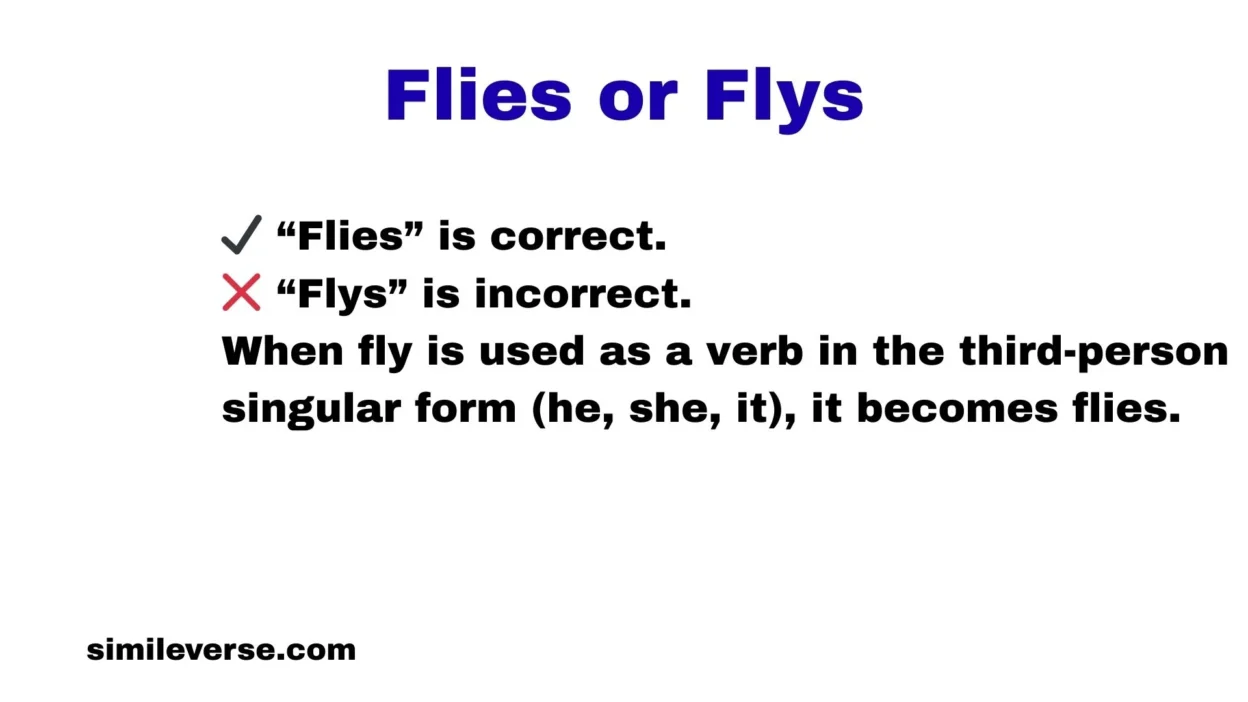
✔️ “Flies” is correct.
❌ “Flys” is incorrect.
When fly is used as a verb in the third-person singular form (he, she, it), it becomes flies.
Examples:
- A bird flies across the sky.
- Time flies when you are happy.
- The plane flies every morning.
👉 “Flys” is not a correct English spelling in standard writing.
The Origin of Flies or Flys
The verb fly comes from Old English flēogan, meaning “to move through the air.” Over time, English developed spelling rules to make verbs easier to read and pronounce.
One important rule is for verbs that end in a consonant + y.
Instead of adding -s directly, English changes the y to i and adds -es.
That is why:
- fly → flies
- cry → cries
- try → tries
The spelling “flys” never became standard because it breaks this long-standing grammar rule.
British English vs American English Spelling
Good news: there is no difference between British and American English for this word.
Both follow the same rule and use flies.
Comparison Table
| Form | American English | British English |
|---|---|---|
| Present tense (he/she/it) | flies ✅ | flies ✅ |
| Incorrect form | flys ❌ | flys ❌ |
📌 Unlike words such as color/colour, this spelling stays the same worldwide.
Which Spelling Should You Use?
Your audience does not change the answer here.
- US audience: Use flies
- UK audience: Use flies
- Canada, Australia, global English: Use flies
If you want to sound professional, fluent, and correct in any English-speaking country, flies is always the right choice.
Common Mistakes with Flies or Flys
Here are mistakes people often make:
❌ Incorrect:
- He flys to New York every week.
- Time flys fast.
✅ Correct:
- He flies to New York every week.
- Time flies fast.
💡 Tip: If the verb ends in consonant + y, change y → i and add es.
Flies or Flys in Everyday Examples
Emails
- ✔️ “She flies to London tomorrow.”
News
- ✔️ “The airline flies over 200 routes daily.”
Social Media
- ✔️ “Wow, time flies 😄”
Formal Writing
- ✔️ “The drone flies at a fixed altitude.”
In all types of writing—casual or formal—flies is the only correct form.
Flies or Flys – Google Trends & Usage Data
Search data shows that “flies or flys” is a common grammar question worldwide.
- “Flies” appears millions of times in books, news, and websites.
- “Flys” mostly appears in searches, spelling questions, or mistakes.
Countries where this confusion is common:
- United States
- United Kingdom
- India
- Pakistan
- Australia
The intent is clear: people want to avoid errors and write better English.
Keyword Variations Comparison Table
| Base Word | Correct Form | Incorrect Form |
|---|---|---|
| fly (verb) | flies | flys |
| cry | cries | crys |
| try | tries | trys |
FAQs About Flies or Flys
1. Is “flys” ever correct?
No. “Flys” is not a correct spelling in standard English.
2. Why does fly become flies?
Because verbs ending in consonant + y change y to i before adding es.
3. Is flies a noun or a verb?
It can be both:
- Verb: “She flies home.”
- Noun: “There are many flies in the room.”
4. Do British and American English differ here?
No. Both use flies.
5. How do I remember the rule?
If it ends in -y, think: y → i → es.
6. Is “flying” related to this rule?
No. “Flying” follows a different verb form rule.
7. Can spellcheck catch “flys”?
Sometimes yes, sometimes no. It’s better to know the rule.
Conclusion
The confusion between flies or flys is common, but the rule is simple once you know it. Flies is always correct, and flys is always wrong in standard English. The verb fly follows a clear spelling rule: when a verb ends in a consonant and y, the y changes to i, and es is added.
This rule applies in American English, British English, and all other forms of modern English. Whether you’re writing an email, a blog post, homework, or a professional document, using flies will keep your writing clear and correct.
If you remember just one thing, remember this:
👉 He flies. She flies. Time flies. Never flys.
Once you learn this pattern, you’ll avoid many similar spelling mistakes and write with more confidence every day.