Many people search for “complement or compliment” because these two words look almost the same but mean very different things. A small spelling change can completely change your sentence—and sometimes your message.
This confusion often appears in emails, social media posts, school writing, and even professional documents. One wrong word can make your writing sound incorrect or unclear.
The problem is simple: both words sound identical, but they are used in different situations. Writers, students, bloggers, and even native English speakers often pause and wonder, “Which one is right here?” That hesitation is exactly why this keyword is so popular.
This article solves that confusion once and for all. You’ll get a quick answer, easy examples, word origins, spelling comparisons, common mistakes, real-life usage, and practical advice on which word to choose.
By the end, you will confidently know when to use complement and when to use compliment, without second-guessing yourself again.
Complement or Compliment – Quick Answer
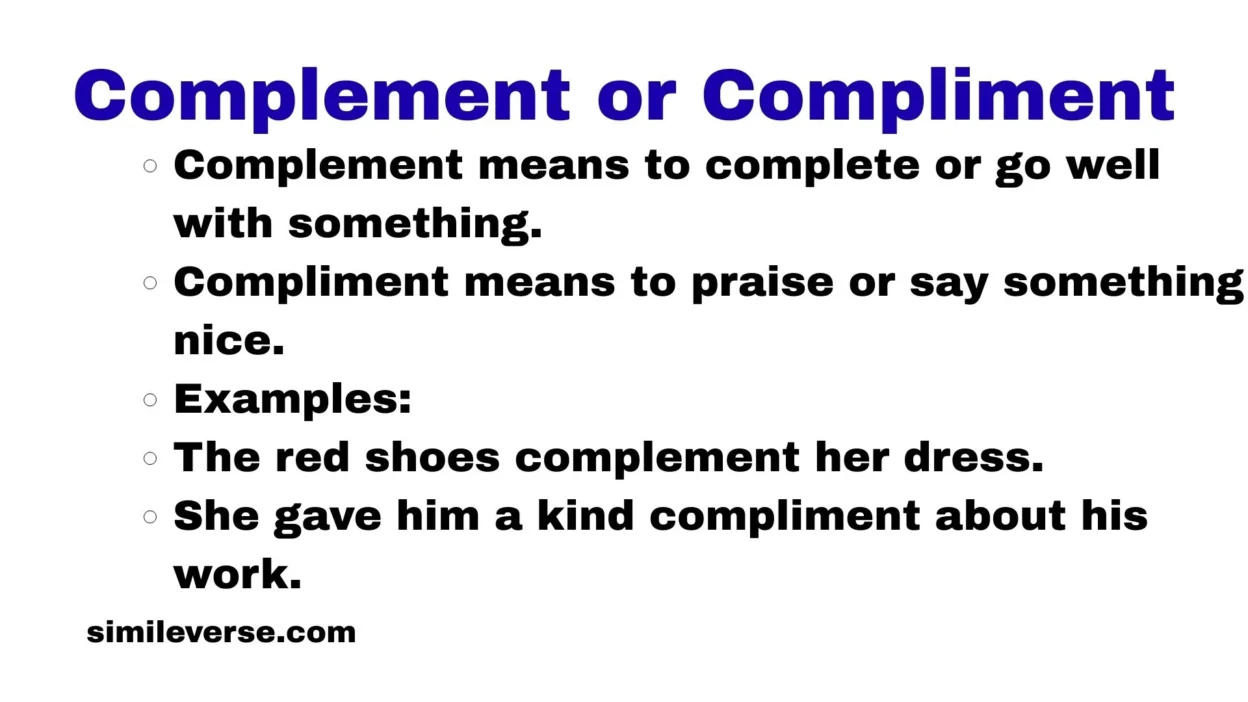
Complement means to complete or go well with something.
Compliment means to praise or say something nice.
Examples:
- The red shoes complement her dress.
- She gave him a kind compliment about his work.
Simple rule to remember:
- Compliment = praise (nice words)
- Complement = completes or matches
The Origin of Complement or Compliment
Both words come from Latin, which is part of the reason they look so similar.
- Complement comes from the Latin word complēre, meaning to fill up or complete. Over time, it became a word used to describe things that complete each other.
- Compliment comes from the Latin complīmentum, meaning expression of courtesy or praise. This evolved into the modern meaning of giving kind words.
Even though they share similar roots, English gave them separate meanings. That is why spelling differences matter so much today.
British English vs American English Spelling
Unlike many confusing words, complement and compliment are spelled the same in both British and American English. The difference is not regional, but meaning-based.
Comparison Table: Meaning-Based Difference
| Word | Meaning | Example Sentence |
|---|---|---|
| Complement | Completes or matches | The wine complements the meal. |
| Compliment | Praise or kind words | She complimented his speech. |
✔ Same spelling in the US and UK
✔ Different meanings everywhere
Which Spelling Should You Use?
The correct choice depends on what you want to say, not where you live.
- US Audience:
Use compliment for praise, complement for matching or completing. - UK & Commonwealth Audience:
Same rule applies. Meaning matters, not spelling style. - Global or SEO Writing:
Choose carefully based on context. Search engines and readers expect the correct word.
Tip:
If you mean nice words, choose compliment.
If you mean things working well together, choose complement.
Common Mistakes with Complement or Compliment
Here are the most frequent errors people make:
❌ Your skills really complement you.
✅ Your skills really compliment you.
❌ She complimented the color of the room.
✅ The color of the room complements the design.
❌ Thank you for the nice complement.
✅ Thank you for the nice compliment.
Fix: Always check if the sentence is about praise or matching.
Complement or Compliment in Everyday Examples
Emails
- I want to compliment you on your excellent presentation.
- Your experience will complement our team.
News
- The new policy complements existing laws.
Social Media
- She received many compliments on her photo.
Formal Writing
- This course is designed to complement your studies.
Complement or Compliment – Google Trends & Usage Data
Search data shows that “complement or compliment” is most popular in:
- The United States
- United Kingdom
- Canada
- Australia
- India
Most searches happen in education, writing help, and professional communication contexts. This shows that people want quick clarity and correct usage, especially for emails, exams, and online content.
Comparison Table: Complement vs Compliment
| Feature | Complement | Compliment |
|---|---|---|
| Meaning | Complete or match | Praise or admire |
| Part of Speech | Noun / Verb | Noun / Verb |
| Emotional Use | Neutral | Positive |
| Common Context | Design, skills, food | People, work, looks |
FAQs About Complement or Compliment
1. Are complement and compliment homophones?
Yes, they sound the same but have different meanings.
2. Can complement be used for people?
Yes, if it means completing or improving something.
3. Is compliment always positive?
Yes, a compliment is always praise.
4. Which word is more common in daily speech?
Compliment is more common in everyday conversation.
5. Can both words be verbs?
Yes. You can complement something or compliment someone.
6. Do British and American English use them differently?
No. The rules are the same in both.
7. How can I remember the difference easily?
Think: “I like it” = compliment.
Conclusion
The confusion between complement or compliment is common, but it is easy to fix once you understand the meaning. Both words sound the same, but they serve very different purposes. Compliment is about kindness, praise, and positive words. Complement is about balance, completion, and things working well together.
If you remember just one rule, let it be this: praise equals compliment, and matching equals complement. This simple trick will help you avoid mistakes in emails, essays, social media posts, and professional writing.
Using the correct word not only improves clarity but also builds trust with your readers. Whether you are a student, writer, or professional, mastering this small detail makes your English stronger and more confident.