If you’ve recently seen the term COCSA on TikTok and felt confused, you’re not alone. Many users come across this abbreviation in comment sections, awareness videos, or serious discussions and immediately search for its meaning. Unlike casual slang, this term carries a sensitive and important meaning. That’s why people want clarity before reacting or sharing content.
On platforms like TikTok, where trends spread quickly, acronyms can gain attention without proper explanation. Sometimes viewers assume it’s just another viral slang term, but in reality, it relates to a serious topic often discussed in educational or awareness contexts.
This article explains what the term means, where it comes from, how it’s used online, and why understanding it correctly matters. We’ll also explore its use in different fields and clarify common misunderstandings.
Meaning & Definition
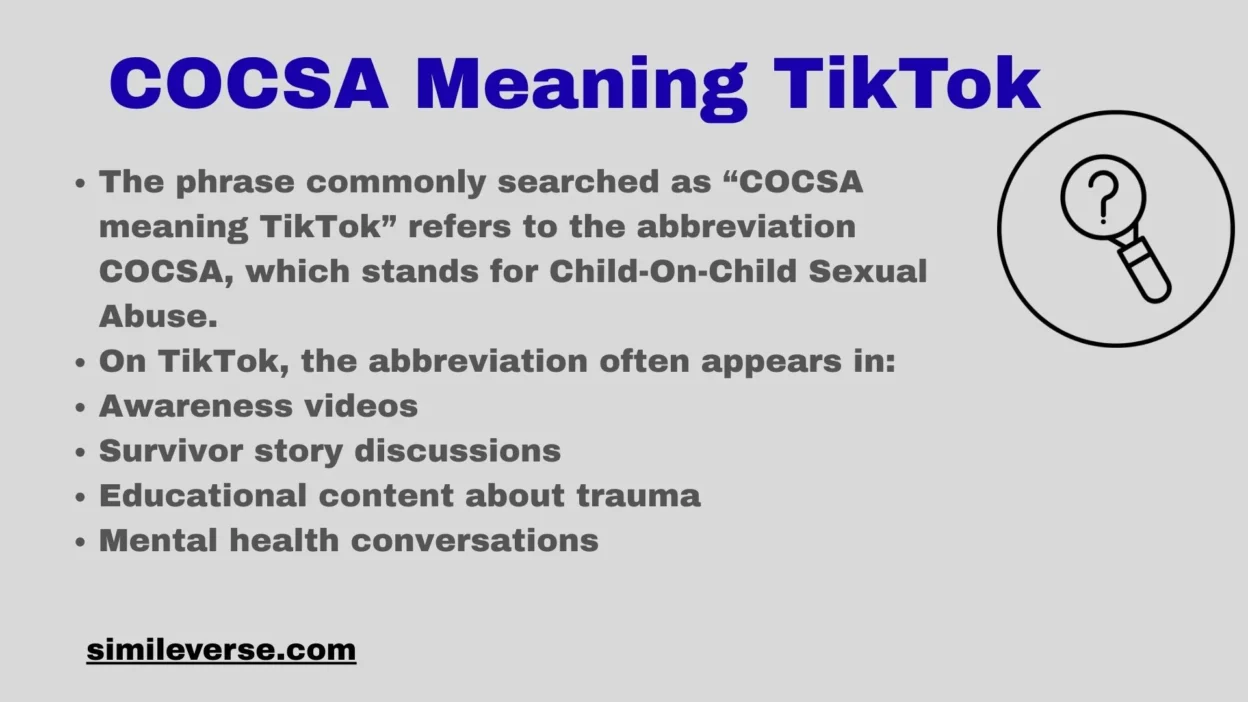
The phrase commonly searched as “COCSA meaning TikTok” refers to the abbreviation COCSA, which stands for Child-On-Child Sexual Abuse.
This term is used in psychology, social work, and child protection discussions. It describes situations where one minor harms another minor in a sexual way. The term is used to differentiate such cases from abuse involving adults.
On TikTok, the abbreviation often appears in:
- Awareness videos
- Survivor story discussions
- Educational content about trauma
- Mental health conversations
It is not slang, a joke, or internet humor. It represents a serious subject related to child safety and psychological wellbeing.
Because TikTok mixes entertainment with educational content, viewers sometimes encounter serious terminology unexpectedly. This leads to confusion and a spike in searches to understand what the acronym stands for.
Understanding the meaning helps prevent misuse and ensures respectful engagement in conversations.
Background
The term COCSA originated in child protection and mental health research. Professionals needed language that accurately described harmful sexual behavior occurring between minors. Using precise terminology helps experts provide appropriate psychological support and legal clarity.
Historically, child abuse discussions mainly focused on adult perpetrators. However, researchers and clinicians recognized that harm between minors also occurs and requires a different approach to intervention and treatment.
With the rise of social media platforms like TikTok, awareness conversations have expanded beyond professional spaces. Survivors and advocates now share experiences publicly to educate others and reduce stigma.
Because TikTok’s algorithm promotes emotional and educational content, videos discussing trauma, recovery, and awareness sometimes go viral. When viewers encounter the acronym without context, curiosity leads them to search for its meaning.
The spread of mental health terminology online has made professional language more visible—but not always clearly explained. That’s why structured explanations are important.
Usage in Different Contexts (Chat, Social Media, Professional Fields)
1. Social Media
On TikTok and similar platforms, the term appears mainly in awareness posts. Users might include it in captions to warn viewers about sensitive content. It is not used casually or humorously.
2. Chat Conversations
In private messages or support groups, the abbreviation may be used to avoid typing out triggering language. It acts as shorthand in serious discussions.
3. Professional Fields
In psychology, counseling, and child welfare services, the full phrase is typically used instead of the acronym. Professionals prioritize clarity and sensitivity.
The difference between online shorthand and professional terminology sometimes causes confusion. Social media prefers abbreviations; professional settings prefer full terms.
Meaning in Chat, WhatsApp, Instagram, TikTok
Across messaging apps like WhatsApp, Instagram, and TikTok, the acronym is typically used for:
- Trigger warnings
- Awareness campaigns
- Educational storytelling
- Mental health discussions
On TikTok specifically, creators may add the term in captions to protect viewers from unexpected sensitive material.
On WhatsApp, it may appear in private support group discussions.
On Instagram, it might be included in educational carousel posts.
The meaning remains the same across platforms — but the context often changes. On TikTok, it may reach a broader audience who are unfamiliar with professional terminology, increasing search interest.
Meaning in Physics, Medical, and Aircraft Terminology
One reason people search for the term is to check whether it has another technical meaning.
Currently:
- It is not a recognized term in physics.
- It is not an official medical diagnosis name.
- It is not used in aircraft or aviation terminology.
There are no scientific or engineering definitions associated with the acronym in standard academic usage.
The confusion usually happens because many acronyms have multiple meanings. However, in this case, the abbreviation is primarily linked to child protection discussions.
Common Misconceptions
Here are common misunderstandings:
1. It’s TikTok slang
It is not slang or a meme.
2. It’s a trending joke
It relates to serious awareness content.
3. It has a secret coded meaning
It is a straightforward professional abbreviation.
4. It refers to adult abuse cases
The term specifically refers to harm between minors.
Misinformation spreads quickly online. When viewers misunderstand sensitive terms, it can lead to inappropriate reactions in comment sections.
Similar Terms & Alternatives
Some related terms include:
- Child sexual abuse (CSA)
- Harmful sexual behavior (HSB)
- Peer abuse
While these terms overlap in discussion topics, they are not identical. For example:
- CSA often refers broadly to abuse involving a child.
- HSB focuses on behavioral patterns.
- Peer abuse can include various types of harm, not only sexual.
Understanding these distinctions helps avoid confusion in educational conversations.
How to Respond to It
If you see the term in a TikTok comment or caption:
- Avoid joking or dismissing it.
- Recognize it likely signals sensitive content.
- If unsure, research from reliable sources.
- Engage respectfully.
If someone shares personal experience involving the term, responding with empathy rather than curiosity is important.
Online discussions about trauma require maturity and understanding.
Differences from Similar Words
It’s important not to confuse this term with:
- General internet slang
- Random letter combinations
- Technical abbreviations
Unlike playful acronyms like “LOL” or “BRB,” this abbreviation represents a serious subject.
It is also distinct from broader abuse terminology because it specifically identifies harm between minors.
Clarity prevents harmful misunderstandings.
Relevance in Online Conversations & Dating Apps
While primarily discussed in awareness spaces, the term occasionally appears in broader online conversations about trauma, therapy, or personal boundaries.
On dating apps, discussions about past trauma sometimes reference sensitive terminology. However, the abbreviation is rarely used casually in dating environments.
The reason it trends is not because of dating culture — but because social media encourages storytelling and mental health openness.
TikTok, in particular, has become a platform where younger generations openly discuss trauma recovery and psychological awareness.
Understanding the term helps users navigate these conversations respectfully.
Conclusion
The search for “cocsa meaning TikTok” usually begins with confusion. Many assume it’s slang, but in reality, it is a serious abbreviation related to child protection discussions. The term appears on TikTok mainly in awareness and educational contexts.
It does not have alternative meanings in physics, aviation, or other scientific fields. Misunderstandings happen because social media spreads abbreviations quickly without explanation.
By learning its correct meaning, users can engage responsibly and avoid spreading misinformation. When encountering sensitive terminology online, awareness and respect should always guide the response.