Have you ever stopped while typing carmel or caramel and wondered which one is actually correct? You’re not alone. This is one of the most searched spelling questions online, especially in food writing, recipes, menus, school assignments, and even brand names. The confusion happens because both words exist, but they do not mean the same thing.
Many people hear the word spoken quickly and assume the spelling drops a letter. Others see “Carmel” used as a name or place and think it applies to food as well. Search engines, autocorrect, and regional accents make the confusion even stronger.
This article solves that confusion clearly and simply. You’ll get a quick answer, learn where both words come from, understand British vs American spelling rules, see real-life examples, and know which spelling you should use based on your audience. By the end, you’ll never hesitate again when choosing between carmel or caramel.
Carmel or Caramel – Quick Answer
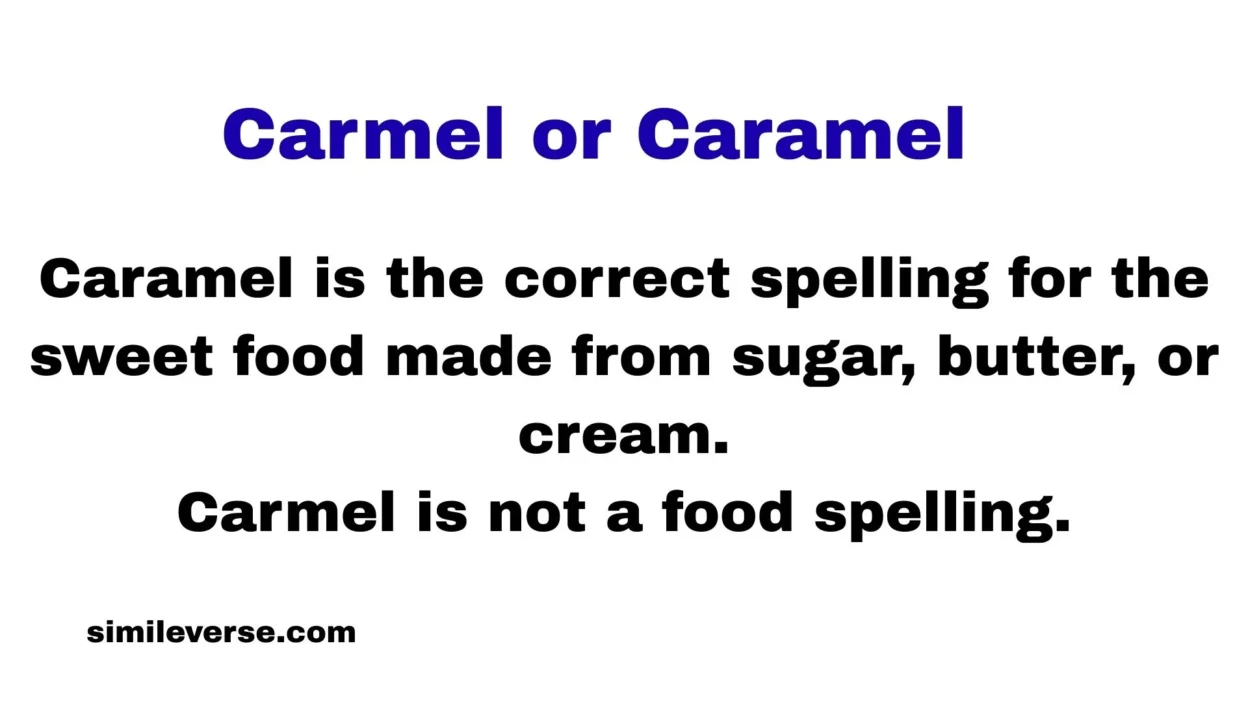
Caramel is the correct spelling for the sweet food made from sugar, butter, or cream.
Carmel is not a food spelling.
Examples:
- ✅ Caramel sauce on ice cream
- ✅ Caramel candy
- ❌ Carmel candy (incorrect)
Carmel is used for:
- Proper nouns (names and places)
- Personal names
- Religious or historical terms
Examples:
- Mount Carmel
- Carmel-by-the-Sea
- Carmel (a person’s name)
👉 If you are talking about food, desserts, or flavors, always use caramel.
The Origin of Carmel or Caramel
Origin of Caramel
The word caramel comes from:
- Late Latin: cannamellis (sugar cane)
- French: caramel
It has always referred to heated sugar used in sweets and desserts. The spelling has stayed consistent across history.
Origin of Carmel
Carmel comes from Hebrew:
- Karmel meaning “garden” or “vineyard”
It is mainly used for:
- Biblical locations
- Place names
- Personal names
Why the Confusion Exists
In spoken English, especially American accents, people often pronounce caramel as:
- “car-mel”
- “car-muhl”
This spoken shortcut causes spelling mistakes, but the written form does not change.
British English vs American English Spelling
Unlike many spelling differences (color vs colour), caramel does NOT change between British and American English.
Key Rule:
- Caramel = food (US & UK)
- Carmel = name/place (US & UK)
Comparison Table
| Usage Type | American English | British English |
|---|---|---|
| Sweet food | Caramel | Caramel |
| Sauce/flavor | Caramel | Caramel |
| Place name | Carmel | Carmel |
| Personal name | Carmel | Carmel |
👉 There is no British spelling “carmel” for food.
Which Spelling Should You Use?
If your audience is in the United States
- Always use caramel for food
- Use Carmel only for names or places
your audience is in the UK or Commonwealth
- Same rule applies
- Caramel is still the only correct food spelling
If your audience is global or online
- Use caramel
- Search engines expect caramel for recipes and food content
✅ SEO tip: Google treats “carmel” as a misspelling when users search for food.
Common Mistakes with Carmel or Caramel
Here are the most frequent errors people make:
❌ Incorrect
- Carmel popcorn
- Carmel sauce
- Carmel apple
✅ Correct
- Caramel popcorn
- Caramel sauce
- Caramel apple
Another Common Mistake
- Thinking “carmel” is an American shortcut
➡️ It is not an accepted spelling for food.
Carmel or Caramel in Everyday Examples
Emails
- ✅ “Please add caramel syrup to my coffee.”
- ❌ “Please add carmel syrup.”
News Articles
- ✅ “The bakery introduced a new caramel dessert.”
- ❌ “A new carmel dessert.”
Social Media
- ✅ “Love this caramel latte ☕”
- ❌ “Best carmel latte ever!”
Formal Writing
- ✅ “Caramel is produced by heating sugar.”
- ❌ “Carmel is produced by heating sugar.”
Carmel or Caramel – Google Trends & Usage Data
Search data shows:
- “Caramel” is heavily searched for:
- Recipes
- Coffee flavors
- Desserts
- “Carmel” spikes for:
- Place searches
- Names
- Schools and churches
Country Trends
- USA: Caramel (food), Carmel (places)
- UK: Caramel almost exclusively
- Global: Caramel dominates food-related searches
👉 This proves that user intent is food-related when “caramel” is used.
Comparison Table: Carmel vs Caramel
| Feature | Carmel | Caramel |
|---|---|---|
| Refers to food | ❌ No | ✅ Yes |
| Correct for desserts | ❌ No | ✅ Yes |
| Place or name | ✅ Yes | ❌ No |
| Used in recipes | ❌ No | ✅ Yes |
| SEO-friendly for food | ❌ No | ✅ Yes |
FAQs: Carmel or Caramel
1. Is “carmel” ever correct for food?
No. Carmel is never correct for food or sweets.
2. Why do people spell caramel as carmel?
Because of pronunciation and accent shortcuts in spoken English.
3. Is caramel spelled differently in British English?
No. Caramel is spelled the same in British and American English.
4. Can brands use “Carmel” for food?
Only as a brand name, not as a correct spelling.
5. Is Carmel a real word?
Yes, but it refers to names and places, not food.
6. Which spelling should I use for SEO?
Always use caramel for food-related content.
7. Does Google correct “carmel” to “caramel”?
Often yes, because it’s considered a common misspelling.
Conclusion
The confusion between carmel or caramel is common, but the rule is simple once you know it. Caramel is the only correct spelling when talking about food, sweets, sauces, or flavors. It does not change between American and British English, and it is the spelling Google, schools, and professionals expect.
Carmel, on the other hand, is a completely different word. It refers to names, places, and historical or religious terms. Using “carmel” for food is a spelling mistake, even if it sounds right when spoken.
If you want to write clearly, rank better in search results, and avoid embarrassment in formal or professional writing, always choose caramel when food is involved. Remember this simple test: If you can eat it, spell it caramel.