Have you ever paused while writing an email, article, or message and wondered: is it “canceling” or “cancelling”? You’re not alone. This is one of the most searched spelling questions in English, especially by students, writers, bloggers, and professionals. Both spellings look right. Both appear in trusted sources. Yet only one may be correct depending on where and how you are writing.
People search for “canceling or cancelling” because English spelling rules change across regions. American English and British English often follow different patterns, which leads to confusion, mistakes, and self-doubt. A single extra “L” can make writers worry about sounding unprofessional or incorrect.
This article clears that confusion once and for all. You’ll get a quick answer, learn why two spellings exist, see British vs American rules, and understand which spelling you should use based on your audience. We’ll also cover common mistakes, real-life examples, usage trends, and FAQs—all in simple, clear language. By the end, you’ll never hesitate again when choosing between canceling and cancelling.
Canceling or Cancelling – Quick Answer
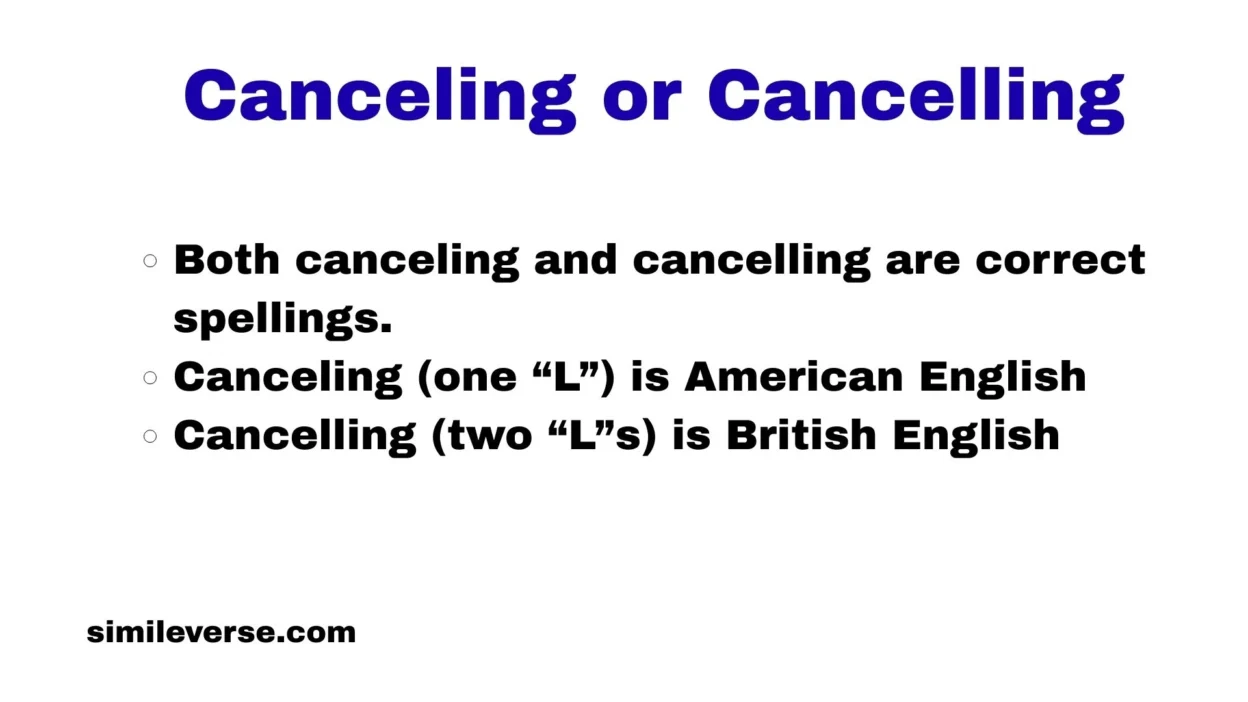
Both canceling and cancelling are correct spellings.
- Canceling (one “L”) is American English
- Cancelling (two “L”s) is British English
Examples:
- 🇺🇸 The airline is canceling the flight due to weather.
- 🇬🇧 The airline is cancelling the flight due to weather.
The meaning is the same. Only the spelling changes.
The Origin of Canceling or Cancelling
The word cancel comes from the Latin word cancellare, meaning “to cross out” or “make void.” It entered English through French in the Middle Ages.
In early English, spelling was not fixed. Writers often doubled consonants freely. Over time, English split into regional forms.
In the 1800s, American lexicographer Noah Webster pushed for simpler spelling. He removed extra letters where possible. This is why American English uses:
- cancel → canceling
- travel → traveling
British English kept older rules, which often double the final consonant:
- cancel → cancelling
- travel → travelling
That historical split is why both spellings still exist today.
British English vs American English Spelling
The main rule difference is consonant doubling.
Rule Explained Simply:
- American English: Do not double the final “L” if the stress is not on the last syllable.
- British English: Always double the final “L” before endings like -ing or -ed.
Comparison Table
| English Type | Present Form | Past Form |
|---|---|---|
| American English | canceling | canceled |
| British English | cancelling | cancelled |
Both are correct within their language systems.
Which Spelling Should You Use?
Choose based on your audience.
- For US audiences (blogs, schools, businesses):
✅ Use canceling - For UK, Australia, Canada, New Zealand:
✅ Use cancelling - For global or mixed audiences:
🔹 Pick one style and stay consistent
🔹 American English is often safer online
Consistency matters more than the spelling itself.
Common Mistakes with Canceling or Cancelling
Here are mistakes many writers make:
- ❌ Mixing styles in one document
✔️ Stick to one form - ❌ Thinking one spelling is wrong
✔️ Both are correct - ❌ Using British spelling in American academic work
✔️ Match the expected style - ❌ Changing spelling randomly in blogs
✔️ Be consistent for SEO and trust
Canceling or Cancelling in Everyday Examples
Emails
- We are canceling the meeting today. (US)
- We are cancelling the meeting today. (UK)
News
- The company is canceling its expansion plans.
- The event was cancelling due to rain.
Social Media
- I’m canceling my subscription.
- They’re cancelling the show tonight.
Formal Writing
- The contract allows canceling within 30 days.
- The policy permits cancelling without notice.
Canceling or Cancelling – Google Trends & Usage Data
Search data shows:
- Canceling is more popular in the United States
- Cancelling dominates in the UK and Commonwealth countries
Globally, canceling appears more often online because American English is widely used in tech, SEO, and media.
Keyword Variation Table
| Variation | Region | Usage Level |
|---|---|---|
| canceling | United States | Very High |
| cancelling | UK & Commonwealth | High |
| canceled | United States | Very High |
| cancelled | UK & Commonwealth | High |
Frequently Asked Questions (FAQs)
1. Is canceling incorrect?
No. It is correct in American English.
2. Is cancelling British English?
Yes. British English uses double “L”.
3. Which spelling does Google prefer?
Google accepts both, but canceling is more common globally.
4. Can I use both in one article?
No. Choose one and stay consistent.
5. What about canceled vs cancelled?
Same rule applies. One “L” for American, two for British.
6. Which should students use?
Follow your school’s language style guide.
7. Does meaning change?
No. The meaning is always the same.
Conclusion
The confusion between canceling or cancelling comes from the natural split between American and British English. Both spellings are correct, accepted, and widely used.
The key is not choosing the “right” one—but choosing the right one for your audience. If you write for American readers, canceling is the best choice. If your audience is in the UK or Commonwealth countries, cancelling is correct.
For global content, American English often works best, especially for SEO, blogs, and online platforms. Still, consistency matters more than the spelling itself. Pick one style and use it everywhere in your content.
Once you understand this rule, spelling becomes easy. No more second-guessing. No more editing stress. You can write with confidence, clarity, and professionalism—every time you see the word cancel.