Have you ever paused while writing and wondered: is it “busses” or “buses”? You’re not alone. This is one of the most common spelling questions in English, especially for students, writers, bloggers, and ESL learners. Both words look correct, both appear online, and both are used in real sentences—so it’s easy to feel confused.
People search for “busses or buses” because English plurals can be tricky. Some words change spelling when made plural, while others stay simple. The confusion grows because both spellings exist, but they do not always mean the same thing. One spelling is correct for vehicles, while the other often belongs to a different verb meaning.
This article clears that confusion once and for all. You’ll get a quick answer, learn the history behind the spellings, see British vs American usage, explore real-life examples, and get clear advice on which spelling you should use. By the end, you’ll know exactly which word fits your sentence—every time.
Busses or Buses – Quick Answer
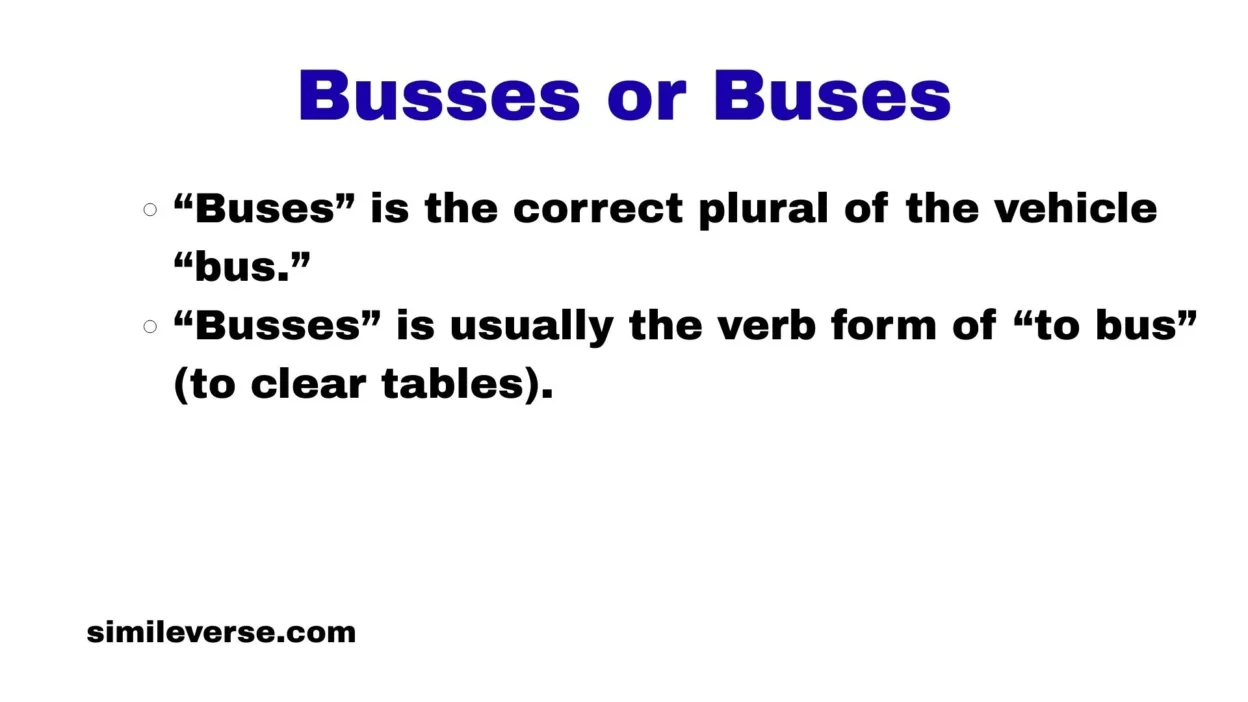
“Buses” is the correct plural of the vehicle “bus.”
“Busses” is usually the verb form of “to bus” (to clear tables).
Examples:
- ✅ The school buses arrive at 8 a.m.
- ✅ City buses are crowded today.
- ❌ The busses are late. (incorrect for vehicles)
Verb use:
- ✅ She busses tables at a restaurant.
- ✅ He bussed the dishes after dinner.
Quick rule:
👉 Talking about vehicles? Use buses.
👉 Talking about clearing tables? busses can be correct.
The Origin of Busses or Buses
The word “bus” comes from the Latin word omnibus, meaning “for all.” In the early 1800s, public transport vehicles were called omnibuses. Over time, people shortened the word to bus.
When English forms plurals, it often adds -es to words ending in -s, -sh, or -ch. That’s why bus → buses became the standard plural for vehicles.
The spelling “busses” appeared later as a verb form, mainly in American English. The verb to bus means to clear tables or transport people, and English verbs often double the final consonant when adding endings.
So:
- Bus (noun) → buses
- Bus (verb) → busses / bussed / bussing
British English vs American English Spelling
Both British and American English agree on the plural of the vehicle.
| Context | British English | American English |
|---|---|---|
| Public transport (noun) | buses | buses |
| Verb (clear tables) | buses / bussed | busses / bussed |
| Most common usage | buses | buses |
Key point:
✔ “Buses” is standard worldwide when you mean vehicles.
✔ “Busses” is more common in American English as a verb.
Which Spelling Should You Use?
Your audience decides the best choice.
- US audience: Use buses for vehicles. Use busses only for the verb.
- UK audience: Use buses almost always.
- Global audience: Stick with buses for clarity and correctness.
Professional advice:
If you are unsure, choose “buses.” It is safe, correct, and widely accepted.
Common Mistakes with Busses or Buses
Here are frequent errors people make:
❌ The city added new busses.
✅ The city added new buses.
❌ Three school busses broke down.
✅ Three school buses broke down.
❌ She buses tables every night. (UK context unclear)
✅ She busses tables every night. (US verb use)
Tip: Most mistakes happen when people apply verb spelling to nouns.
Busses or Buses in Everyday Examples
Emails
- The company provides shuttle buses for staff.
News
- Electric buses reduce air pollution.
Social Media
- Waiting for late-night buses again 😩
Formal Writing
- Public buses play a key role in urban transport.
Busses or Buses – Google Trends & Usage Data
Search data shows “buses” is far more popular than “busses” worldwide.
- United States: “buses” dominates for transport topics
- United Kingdom: almost exclusive use of “buses”
- <strong>Canada & Australia: strong preference for “buses”
- “Busses” searches: mostly related to grammar questions or restaurant work
This proves that user intent is usually about the vehicle, not the verb.
Comparison Table: Busses vs Buses
| Form | Part of Speech | Meaning | Correct Example |
|---|---|---|---|
| buses | Noun (plural) | Vehicles | City buses are clean |
| buses | Verb | Transport | The school buses students |
| busses | Verb | Clears tables | She busses tables |
| busses | Noun (rare) | Kisses (archaic) | Very uncommon |
FAQs: Busses or Buses
1. Is “busses” ever correct?
Yes, but mainly as a verb, not for vehicles.
2. What is the plural of bus?
The correct plural is buses.
3. Do Americans use “busses”?
Only for the verb form, not for transport vehicles.
4. Is “busses” wrong in British English?
It is very rare and usually avoided.
5. Which spelling is better for SEO?
“Buses”—it matches user intent and search volume.
6. Can “bus” have two plural forms?
Technically yes, but they serve different meanings.
7. What should students use in exams?
Always use buses for vehicles.
Conclusion
The confusion between busses or buses comes from English having one word with two roles: a noun and a verb. When you are talking about public transport, school transport, or city travel, “buses” is always correct. It is accepted in American, British, and global English. The spelling “busses” mainly belongs to the verb meaning to clear tables, and even then, it is more common in American usage.
For writers, students, bloggers, and professionals, the safest and smartest choice is simple: use “buses” unless you clearly mean the verb. This avoids mistakes, improves clarity, and matches how most people read and search online. Remember this rule, and you’ll never hesitate again.