Have you ever stopped while writing and wondered: Is it “ax” or “axe”? You’re not alone. This is one of those small spelling questions that shows up in schoolwork, emails, blog posts, news articles, and even Google searches. People search for “ax or axe” because both spellings look correct, both appear in books, and both are used by native English speakers. That can be confusing, especially for learners, writers, and professionals who want to sound polished.
The confusion happens because English is not one single system. British English and American English often spell the same word differently. Think of color vs colour or organize vs organise. Ax or axe fits into this same pattern. One spelling is shorter and modern in some places, while the other keeps an older form of the word.
This article clears up that confusion once and for all. You’ll get a quick answer, learn where the word came from, see how spelling changes by region, and find out which version you should use. By the end, you’ll know exactly when to write ax and when to write axe—with confidence.
Ax or Axe – Quick Answer
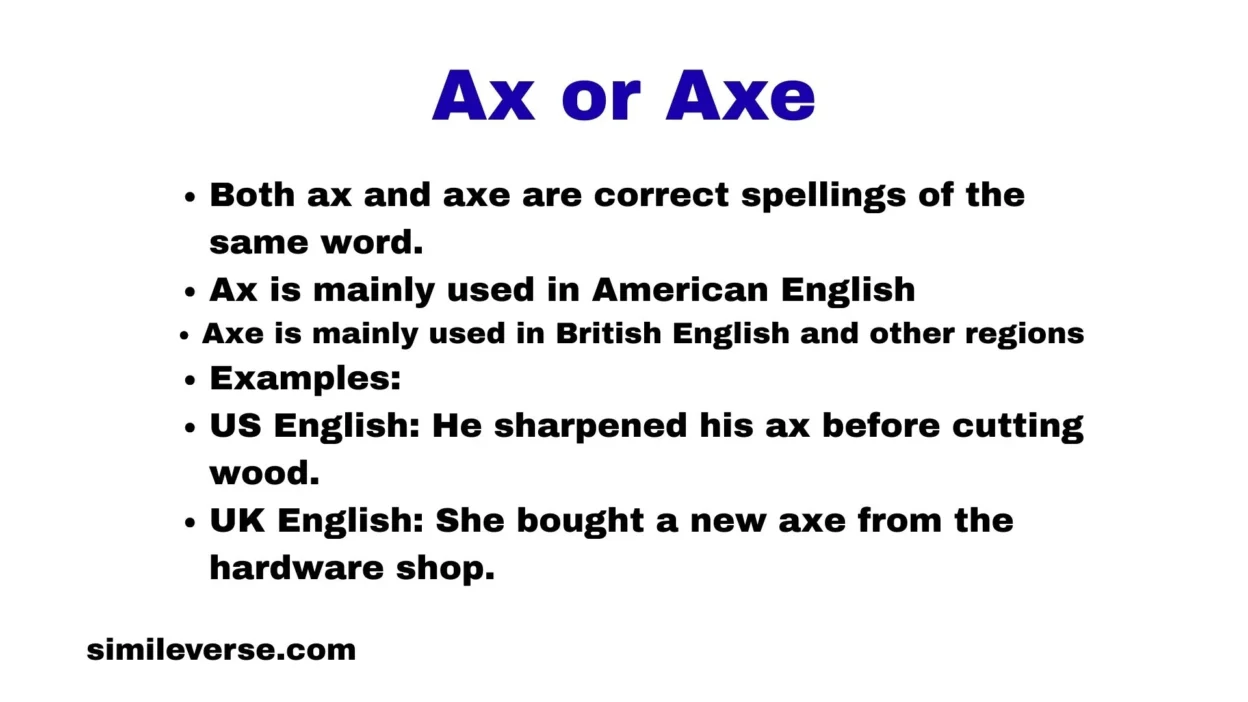
Both ax and axe are correct spellings of the same word.
- Ax is mainly used in American English
- Axe is mainly used in British English and other regions
Examples:
- US English: He sharpened his ax before cutting wood.
- UK English: She bought a new axe from the hardware shop.
Meaning stays the same in both cases: a tool with a sharp blade used for cutting wood, or sometimes used in a figurative sense.
The Origin of Ax or Axe
The word comes from Old English “æx” or “eax.”
It is also linked to Old Norse and Germanic languages, where similar spellings existed.
In early English, both spellings were common:
- Ax was a shorter form
- Axe kept the extra “e” as spelling rules became more fixed
Over time, English split into regional standards. American English favored simpler spellings, while British English kept many traditional forms. That is why both spellings survived and are still correct today.
British English vs American English Spelling
The difference between ax and axe is mainly regional.
| English Type | Preferred Spelling | Example Sentence |
|---|---|---|
| American English | Ax | He carried an ax into the forest. |
| British English | Axe | The fireman held an axe. |
| Canadian English | Axe | She used an axe to chop wood. |
| Australian English | Axe | An axe was hanging on the wall. |
Rule to remember:
American English often removes extra letters. British English usually keeps them.
Which Spelling Should You Use?
Choose your spelling based on your audience.
- Writing for the US: Use ax
- Writing for the UK or Commonwealth countries: Use axe
- Global or mixed audience: axe is often safer and more widely accepted
- Academic or formal writing: Follow the style guide you are using
Consistency matters more than choice. Pick one spelling and stick with it.
Common Mistakes with Ax or Axe
Here are mistakes people often make:
- ❌ Mixing spellings in one article
✅ Use only ax or only axe - ❌ Thinking one spelling is wrong
✅ Both are correct - ❌ Changing spelling without changing audience
✅ Match spelling to region - ❌ Assuming “ax” is informal
✅ “Ax” is standard in American English
Ax or Axe in Everyday Examples
Emails:
- Please remove the old ax from storage.
- The broken axe needs repair.
News:
- The suspect attacked the door with an axe.
- A vintage ax was found at the site.
Social Media:
- Just bought a new axe for camping!
- This ax cuts like a dream.
Formal Writing:
- The firefighter used an axe to break the window.
Ax or Axe – Google Trends & Usage Data
Search data shows clear regional patterns:
- Ax is searched more in the United States
- Axe is searched more in the UK, Canada, Australia, and India
- Globally, axe appears slightly more often due to wider international use
Context also matters:
- Tool and hardware topics favor axe
- Short headlines in US media often use ax
Ax vs Axe Comparison Table
| Feature | Ax | Axe |
|---|---|---|
| Meaning | Same | Same |
| Region | United States | UK, Canada, Australia |
| Formal Use | Yes | Yes |
| Informal Use | Yes | Yes |
| Correct English | Yes | Yes |
FAQs About Ax or Axe
1. Is “ax” incorrect English?
No. It is correct in American English.
2. Is “axe” more formal than “ax”?
No. Both are equally formal.
3. Which spelling is older?
“Axe” comes from older written forms, but both are ancient.
4. Can I use both in one article?
No. Choose one and stay consistent.
5. Which spelling should students use?
Follow your school’s English style or country standard.
6. Does pronunciation change?
No. Both are pronounced the same.
7. Which spelling is better for SEO?
Use the one your target audience searches for.
Conclusion
The debate over ax or axe is not about right or wrong—it’s about where and who you’re writing for. Both spellings mean the same thing, sound the same, and come from the same historical root. The difference exists because English evolved differently in different regions. American English prefers ax, while British and Commonwealth English prefer axe.
If your audience is in the United States, ax is the natural choice. If your readers are in the UK, Canada, or Australia, axe will feel more familiar. For global or mixed audiences, axe is often the safer option. The most important rule is consistency. Pick one spelling, match it to your audience, and use it throughout your writing.
Once you understand this simple rule, the confusion disappears—and you can write with clarity and confidence every time.