If you’ve ever highlighted a sentence in a book, added a comment to a document, or seen notes attached to a social media post, you’ve already encountered annotation in action.
Many people search for annotation meaning because the word appears in different places—school assignments, research papers, online chats, software tools, and even scientific fields. The confusion grows when the same term is used in casual texting and technical subjects like physics or medicine.
At its core, annotation refers to adding extra information, explanation, or commentary to something. However, its exact meaning can shift slightly depending on the context. In this article, we’ll break it down in simple language.
You’ll learn what it truly means, where it came from, how it’s used in everyday conversations, and how it differs from similar words. By the end, you’ll clearly understand annotation and how to respond when you encounter it.
Meaning & Definition
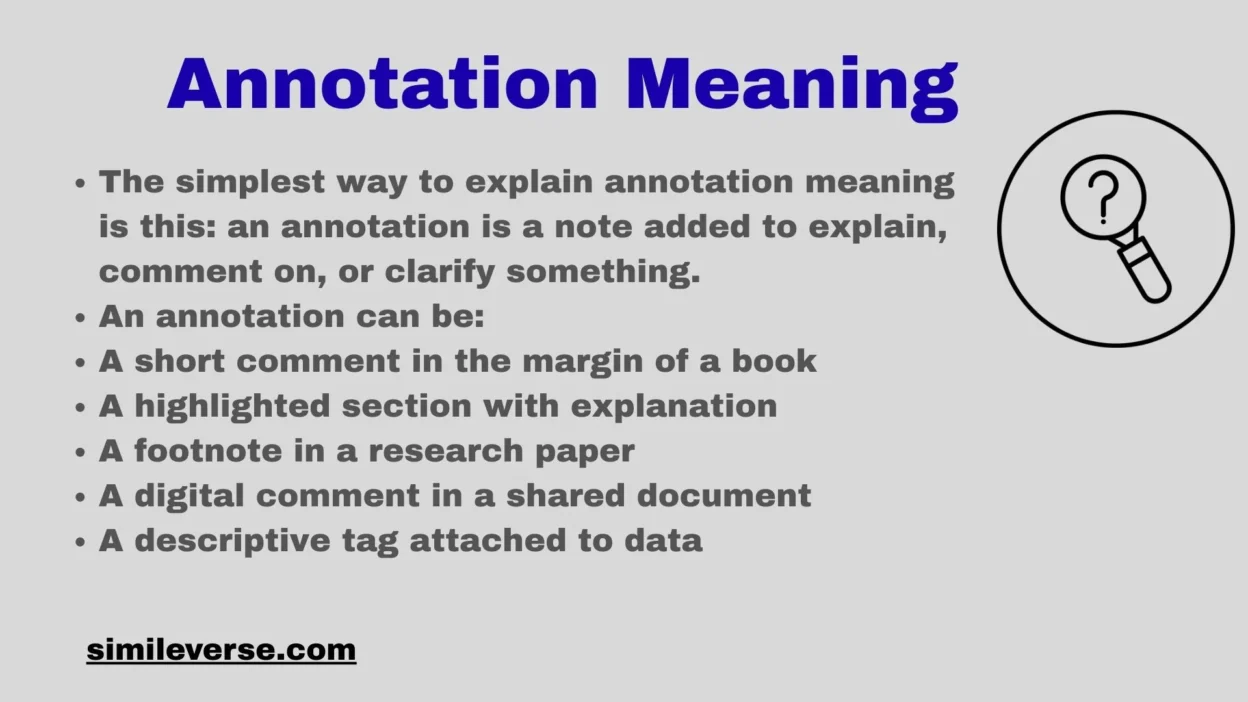
The simplest way to explain annotation meaning is this: an annotation is a note added to explain, comment on, or clarify something.
An annotation can be:
- A short comment in the margin of a book
- A highlighted section with explanation
- A footnote in a research paper
- A digital comment in a shared document
- A descriptive tag attached to data
The word comes from the idea of “noting” something down. When you annotate, you are adding meaning to existing content.
For example:
- A teacher writes comments on a student’s essay.
- A reader highlights a quote and writes thoughts next to it.
- A YouTube creator adds clickable text notes in a video (historically called annotations).
In digital tools like Google Docs or Microsoft Word, annotations appear as comments that help collaborators understand suggestions or corrections. In research, annotations help explain complex information.
So, annotation does not replace the original content. Instead, it adds context, explanation, or interpretation to it.
Background
The concept behind annotation is centuries old. Scholars in ancient libraries used handwritten notes in the margins of manuscripts. These notes were called “marginalia.” They helped readers interpret religious texts, literature, and philosophical works.
During the Middle Ages, monks copied manuscripts and often added clarifying notes. Later, during the printing era, footnotes and endnotes became popular forms of annotation.
In modern times, digital platforms expanded the idea:
- In academic research, annotated bibliographies summarize and evaluate sources.
- In programming, annotations mark special instructions in code.
- In video platforms like early versions of YouTube, annotations were clickable notes added directly onto videos.
The digital transformation has made annotation faster and more interactive. Instead of writing in margins, people now add comments in shared files, PDFs, and apps.
The basic idea, however, has remained the same for centuries: adding extra information to improve understanding.
Usage in Different Contexts (Chat, Social Media, Professional Fields)
Understanding annotation meaning requires looking at how it changes across contexts.
1. In Academic and Professional Settings
In schools and universities, annotation is a learning technique. Students annotate texts to:
- Identify important themes
- Analyze characters
- Highlight arguments
- Add personal interpretations
In business environments, annotations appear in:
- Project documents
- Contracts
- Design drafts
- Shared reports
Professionals use annotations to suggest edits, clarify misunderstandings, and collaborate efficiently.
2. In Technology and Data
In data science, annotation refers to labeling data. For example:
- Tagging images with descriptions
- Marking objects in photos
- Labeling speech recordings
This helps train artificial intelligence systems.
3. In Casual Conversation
Sometimes people casually say, “Add an annotation,” meaning “add a note” or “explain this part.”
The core idea always stays consistent: extra information attached to something.
Meaning in Chat, WhatsApp, Instagram, TikTok
On messaging platforms like WhatsApp, Instagram, and TikTok, annotation is not usually slang—but it can refer to added text or notes on content.
For example:
- On Instagram stories, users add text overlays.
- On TikTok videos, creators insert on-screen explanations.
- On WhatsApp images, users draw arrows or write captions.
These added elements function as annotations because they clarify or emphasize parts of the content.
In group chats, someone might say:
“Please annotate this screenshot.”
That means:
“Add explanations or highlight important parts.”
It is not a secret code or slang term. It simply refers to adding commentary or explanation to shared media.
Meaning in Physics, Medical, and Aircraft Terminology
In technical fields, annotation meaning becomes more specialized.
Physics
In physics, annotations may appear in diagrams or formulas. Scientists annotate graphs to explain variables, forces, or measurements.
Medical Field
In medicine, doctors annotate:
- Medical images (like X-rays)
- Lab reports
- Patient charts
These notes clarify findings or highlight abnormalities.
Aircraft Terminology
In aviation manuals, annotations may explain technical diagrams, maintenance steps, or safety instructions. Pilots and engineers rely on clear annotations to prevent misunderstandings.
In all these cases, annotations provide clarity in complex systems where mistakes could be costly or dangerous.
Common Misconceptions
There are several misunderstandings about annotation meaning:
1. Annotation means correction.
Not always. It can include corrections, but it mainly adds explanation.
2. Annotation is only academic.
False. It appears in technology, medicine, social media, and everyday communication.
3. Annotation replaces content.
No. It supplements existing material.
4. Annotation is a slang term.
It is a formal word, though it can be used casually online.
Understanding these distinctions prevents confusion.
Similar Terms & Alternatives
People often confuse annotation with similar words:
- Comment
- Note
- Remark
- Footnote
- Explanation
- Highlight
While these words are related, annotation is broader. A footnote is a type of annotation. A comment is also a type of annotation. But annotation includes any added explanatory material.
How to Respond to It
If someone asks you to annotate something:
- Read the material carefully.
- Highlight important parts.
- Add short, clear notes.
- Keep explanations relevant.
If someone says, “See my annotations,” they mean:
“Check the notes I added.”
A simple response could be:
“Thanks, I’ll review your annotations.”
Differences from Similar Words
Annotation vs Comment:
A comment is usually shorter and conversational. Annotation may include deeper explanation.
Annotation vs Summary:
A summary rewrites content briefly. Annotation adds notes without rewriting everything.
Annotation vs Footnote:
A footnote appears at the bottom of a page. Annotation can appear anywhere—margin, inline, or digital overlay.
Relevance in Online Conversations & Dating Apps
In online conversations and dating apps, annotation is less formal but still relevant.
For example:
- Someone screenshots a chat and annotates it with arrows and notes.
- A person highlights parts of a profile and comments on them.
In these spaces, annotations help clarify tone or emphasize meaning. Since online communication lacks facial expressions, annotations can prevent misunderstandings.
However, over-annotating messages can sometimes seem unnecessary or dramatic. It’s best used when clarity is needed.
Conclusion
Understanding annotation meaning becomes simple once you break it down. At its core, annotation refers to adding notes, explanations, or commentary to existing content. If in textbooks, research papers, medical reports, aircraft manuals, or social media posts, its purpose remains consistent—clarity and context.
Though the word appears technical, its function is something we do daily: highlight, comment, and explain. From ancient handwritten manuscripts to modern digital documents, annotation continues to play a vital role in communication.
The next time someone asks you to annotate something, you’ll know exactly what they mean—and how to respond confidently.