The phrase “all or nothing” is short, powerful, and used everywhere—from daily conversations to business talks and motivational speeches. People often search for this keyword because they want to understand what it really means, how to use it correctly, and whether there are spelling or usage differences across regions. Some are confused about whether it’s a phrase, an idiom, or a mindset. Others want to know if it should be hyphenated or written differently in British or American English.
This article solves all of that confusion in one place.
At its core, all or nothing describes a situation where there are only two choices: total success or total failure, full effort or none at all. There is no middle ground. Because the phrase is common in emails, news headlines, self-help content, and social media, using it correctly matters—especially for writers, students, and professionals.
Below, you’ll find a quick answer, the origin of the phrase, spelling comparisons, common mistakes, real-life examples, usage trends, and clear advice on when and how to use all or nothing with confidence.
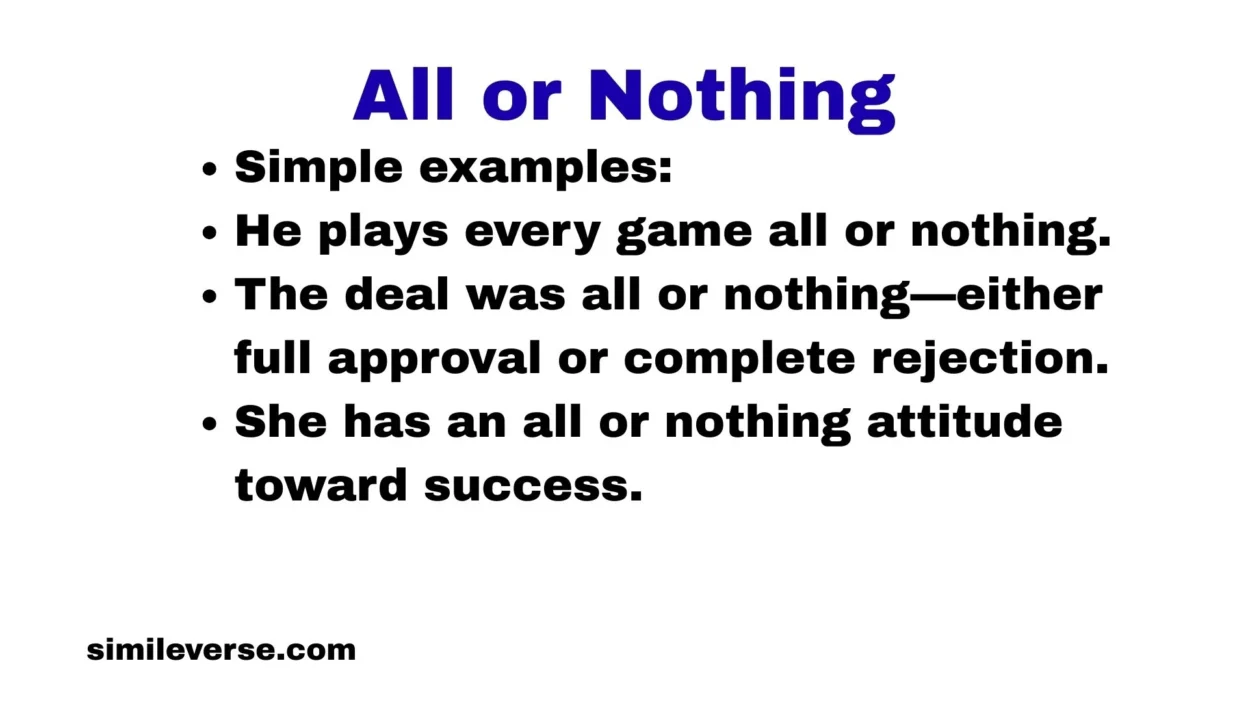
All or Nothing
All or nothing means giving everything or getting nothing at all, with no partial result.
Simple examples:
- He plays every game all or nothing.
- The deal was all or nothing—either full approval or complete rejection.
- She has an all or nothing attitude toward success.
It can describe:
- A decision (accept everything or reject it)
- An attitude (total effort, no half measures)
- A situation (win everything or lose everything)
The Origin of All or Nothing
The phrase all or nothing dates back to the early 17th century. It grew from everyday speech where people described risky choices—especially in trade, gambling, and warfare—where outcomes were extreme.
Over time, it became a fixed idiom in English, meaning:
- Complete success or
- Complete failure
There are no spelling variations of all or nothing. It has always been written as three separate words. Any confusion usually comes from hyphenation, not spelling differences.
British English vs American English Spelling
Good news: British English and American English use the same spelling for all or nothing.
The only difference appears in hyphen usage, depending on sentence structure.
Comparison Table
| Usage Form | British English | American English | Example |
|---|---|---|---|
| Phrase (general use) | all or nothing | all or nothing | It’s all or nothing. |
| Adjective (before noun) | all-or-nothing | all-or-nothing | An all-or-nothing decision |
| Verb phrase | all or nothing | all or nothing | He lives all or nothing |
✔ Same spelling
✔ Same meaning
✔ Same rules
Which Spelling Should You Use?
You should always use “all or nothing” as the base phrase.
Use all-or-nothing (with hyphens) only when it describes a noun.
Audience-based advice:
- US audience: all or nothing / all-or-nothing
- UK & Commonwealth: all or nothing / all-or-nothing
- Global audience: same usage works everywhere
There is no regional spelling difference, so you’re safe using this phrase worldwide.
Common Mistakes with All or Nothing
Here are frequent errors and how to fix them:
❌ Its an all or nothing decision
✔ It’s an all-or-nothing decision
❌ Overusing hyphens
✔ Use hyphens only before nouns
All or Nothing in Everyday Examples
Emails
- “This proposal is all or nothing, so please review carefully.”
News
- “The vote became an all-or-nothing moment for the government.”
Social Media
- “New year, all or nothing 💪”
Formal Writing
- “The policy represents an all-or-nothing approach to reform.”
All or Nothing – Google Trends & Usage Data
The phrase all or nothing is popular in:
- United States
- United Kingdom
- Canada
- Australia
- India
It’s often searched in contexts like:
- Motivation and mindset
- Business decisions
- Relationships
- Psychology and self-help
Search interest stays steady because it’s timeless, emotional, and widely used in spoken and written English.
Keyword Variations Comparison Table
| Variation | Correct? | Usage |
|---|---|---|
| all or nothing | ✅ Yes | General phrase |
| all-or-nothing | ✅ Yes | Adjective form |
| allornothing | ❌ No | Incorrect |
| all/nothing | ❌ No | Incorrect |
| all or nothing mindset | ✅ Yes | Common phrase |
FAQs About All or Nothing
1. Is all or nothing an idiom?
Yes. It’s a common English idiom with a fixed meaning.
2. Should all or nothing be hyphenated?
Only when it comes before a noun.
3. Does British English spell it differently?
No. The spelling is the same in all English varieties.
4. Is all or nothing formal or informal?
It works in both casual and formal writing.
5. Can all or nothing describe a personality?
Yes. It often describes extreme or perfectionist thinking.
6. Is all or nothing negative?
Not always. It can be motivating or risky, depending on context.
7. Can I use it in academic writing?
Yes, but use it carefully and sparingly.
Conclusion
The phrase all or nothing is simple, strong, and universal. It describes situations where there is no middle ground—only full commitment or total loss.
There are no spelling differences between British and American English, which makes it easy to use across global audiences. The only thing to watch is hyphenation, which depends on sentence structure, not region.
Whether you’re writing an email, a blog post, a headline, or a formal report, all or nothing fits naturally when describing high-stakes decisions or intense attitudes. By understanding its meaning, origin, and correct usage, you avoid common mistakes and sound confident and professional.
If your goal is clarity, impact, and correct English, all or nothing is a phrase you can safely use—anywhere, anytime, and for any audience.