“Affects or effects?” is one of the most searched grammar questions online—and for good reason. These two words look similar, sound similar, and often appear in the same sentences. That makes them easy to mix up, even for fluent English users. Students worry about marks. Professionals worry about emails. Writers worry about clarity. One small spelling choice can change meaning, tone, and trust.
People search this keyword because they want a fast answer they can use right away, plus a clear rule they can remember later. Some guides feel too technical. Others are too short and skip real examples. This article fixes that problem.
Here, you’ll get a quick rule, plain explanations, and everyday examples. You’ll learn where the words came from, how British and American English treat them, and which one you should use for your audience. We’ll also cover common mistakes, show real-life usage, and explain how popular each word is today. By the end, you’ll know exactly when to use affects and when to use effects—with confidence.
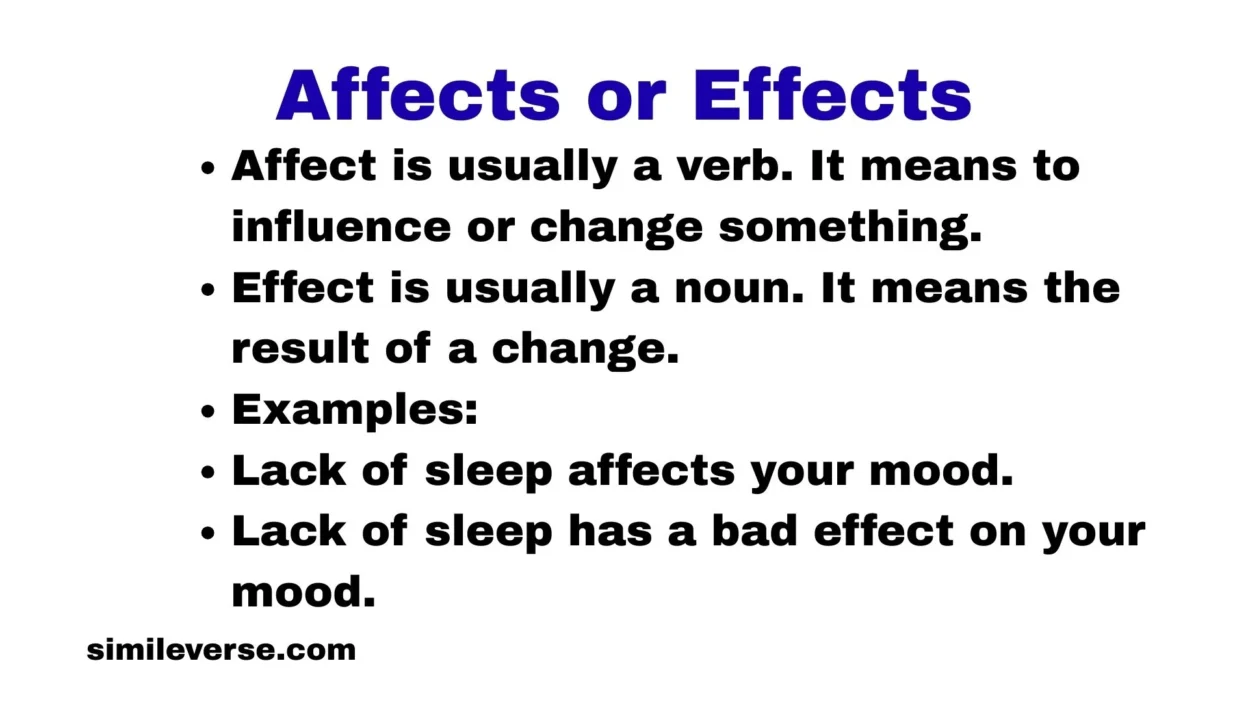
Affects or Effects
Affect is usually a verb. It means to influence or change something.
Effect is usually a noun. It means the result of a change.
Examples:
- Lack of sleep affects your mood.
- Lack of sleep has a bad effect on your mood.
Easy memory trick:
- Affect = Action (both start with A)
- Effect = End result
The Origin of Affects or Effects
Both words come from Latin.
- Affect comes from afficere, meaning “to act on” or “to influence.”
- Effect comes from effectus, meaning “result” or “outcome.”
Over time, English kept both words but gave them different jobs. One became an action word. The other became a result word. That history explains why they look alike but work differently. The confusion stayed because English borrowed words from many languages without simplifying spellings.
British English vs American English Spelling
Good news: there is no spelling difference between British and American English for these words. The rules are the same everywhere.
| Aspect | British English | American English |
|---|---|---|
| Verb form | affect | affect |
| Noun form | effect | effect |
| Meaning | Same | Same |
| Usage rules | Same | Same |
The confusion is about function, not spelling.
Which Spelling Should You Use?
Choose based on meaning, not country.
- US audience: Use affect for actions, effect for results.
- UK & Commonwealth: Same rule applies.
- Global audience: Keep sentences simple. When unsure, rewrite.
Tip: If you can replace the word with “influence,” use affect.
If you can replace it with “result,” use effect.
Common Mistakes with Affects or Effects
Mistake 1: Using effect as a verb by accident
❌ This policy will effect prices.
✅ This policy will affect prices.
Mistake 2: Using affect as a noun
❌ The affect was positive.
✅ The effect was positive.
3: Guessing instead of checking
Quick check saves embarrassment.
Affects or Effects in Everyday Examples
Emails:
- This delay may affect delivery time.
News:
- The storm had serious effects on traffic.
Social Media:
- Coffee affects my sleep 😴
Formal Writing:
- The law had long-term effects on the economy.
Affects or Effects
Search data shows people around the world ask this question daily. Students, bloggers, and office workers lead the searches. “Affect vs effect” spikes during exam seasons and workdays. Both words are common, but effect appears more in news and research, while affect appears more in advice and health topics. The confusion is global and ongoing.
Affects vs Effects – Side-by-Side Comparison
| Word | Part of Speech | Meaning | Example |
|---|---|---|---|
| Affect | Verb | To influence | Stress can affect health. |
| Effect | Noun | Result | Stress has an effect on health. |
FAQs: Affects or Effects
1. Can affect ever be a noun?
Yes, but it is rare and used in psychology.
2. Can effect be a verb?
Yes, but it means “to cause,” and it is uncommon.
3. Which one is more common?
Effect is more common in writing.
4. Is this a British vs American issue?
No. The rules are the same.
5. What’s the easiest rule to remember?
Affect = action. Effect = end result.
6. Are both correct in exams?
Only if used correctly in context.
Conclusion
The confusion around affects or effects is normal, but it is also easy to fix. Most of the time, affect is a verb that shows action or influence. Effect is a noun that shows the result. This simple rule works in emails, exams, articles, and everyday writing.
There is no British or American spelling difference to worry about. That makes your job easier. Focus on meaning. If the word shows change happening, use affect. If it shows what happened because of that change, use effect. When in doubt, try swapping the word with “influence” or “result.” The right choice becomes clear fast.
Clear writing builds trust. Correct word choice shows confidence. Now that you understand affects or effects, you can write without guessing—and without second thoughts.